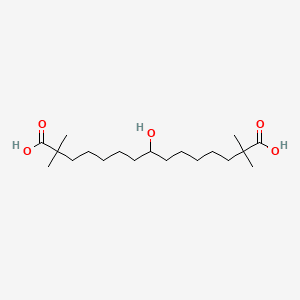

Bempedoic Acid is an oral, once-daily ATP-citrate lyase inhibitor and prodrug activated by hepatic ACSVL1 enzyme. By interrupting early cholesterol biosynthesis, it lowers LDL-C and is indicated for patients intolerant to statins or requiring additional LDL-C reduction. Bempedoic Acid manufactured on the purpose of Cardiovascular Therapeutic Agent end usage. It is also called as ETC-1002, acido bempedoico, Nexletol by suppliers.

Bempedoic Acid is an oral, once-daily ATP-citrate lyase inhibitor and prodrug activated by hepatic ACSVL1 enzyme. By interrupting early cholesterol biosynthesis, it lowers LDL-C and is indicated for patients intolerant to statins or requiring additional LDL-C reduction. Bempedoic Acid manufactured on the purpose of Cardiovascular Therapeutic Agent end usage. It is also called as ETC-1002, acido bempedoico, Nexletol by suppliers.

Chemical Properties & Specifications
Low systemic toxicity; non-carcinogenic; avoid ingestion. Not classified as hazardous under standard lab handling.
Use standard lab PPE.
Non-carcinogenic, non-mutagenic (per ICH S2(R1))
Serves as a prodrug that inhibits ACL in hepatocytes, effectively reducing hepatic cholesterol and LDL-C levels.
Used in the formulation of Nexletol® and fixed-dose combinations (e.g., with ezetimibe).
R&D and commercial production of lipid-lowering pharmaceuticals, particularly for patients unable to tolerate statins.
Requires hepatic ACSVL1 enzyme-confers liver-specific activity, reducing muscle toxicity
Inhibits ACL and activates AMPK in vitro- may confer anti-inflammatory effects
Weak inhibition of OATPs and OATs; no CYP450 involvement minimizes interaction risk
Low solubility, high permeability critical for formulation strategies
Store at 2–8 °C in a tightly sealed container; protect from moisture.
It undergoes hepatic conversion by ACSVL1 to its CoA thioester, which then inhibits ATP-citrate lyase.
Liver-specific activation prevents muscle uptake, differentiating it from statins What is its impact on LDL-C levels? Reductions of 20–25% LDL-C observed in Phase III CLEAR trials Are there any relevant drug interactions? Minimal — weak interaction with OATP/OAT; no CYP450 involvement . What are its pharmacokinetics? Tmax ~3.5 h; half-life ~21 h; steady-state achieved in ~1 week What is the solubility profile for formulation? Soluble in alcohol and phosphate buffer pH 8 but insoluble below pH 5 — key for oral dosage design"
Reductions of 20–25% LDL-C observed in Phase III CLEAR trials.
Minimal- weak interaction with OATP/OAT; no CYP450 involvement.
Tmax ~3.5 h; half-life ~21 h; steady-state achieved in ~1 week.
Soluble in alcohol and phosphate buffer pH 8 but insoluble below pH 5- key for oral dosage design.
It inhibits ACL rather than HMG-CoA reductase, offering cholesterol-lowering effects without statin-associated muscle risks.
Due to low aqueous solubility, formulations typically employ basic buffers or lipid-based carriers to enhance bioavailability.
The drug is a prodrug activated by liver-specific ACSVL1 to its CoA thioester, enabling selective hepatic action.
Minimal, as it is not metabolized via CYP450. Weak inhibition of OATP2 and OAT3 transporters is noted.
Often co-administered with ezetimibe or statins to achieve optimal LDL-C control.
Prescription-only API (Rx), non-narcotic, non-scheduled under NDPS
Category : Pharmaceutical Actives & Precursors
Sub-Category : Intermediates & Precursors
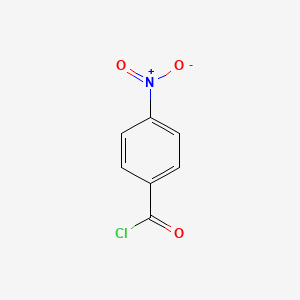
Description : P-Nitrobenzoyl Chloride (CAS 122-04-3) is a critical building block in the API intermediates market,...