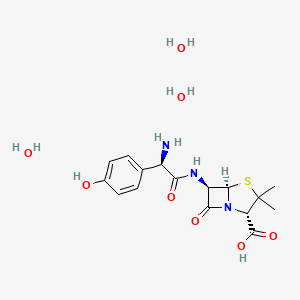

Amoxicillin Trihydrate (CAS 61336-70-7) is a foundational Semi-Synthetic, Broad-Spectrum Aminopenicillin API within the beta-lactam class, valued for its enhanced stability and superior oral bioavailability in its trihydrate form. Therapeutic power is rooted in its bactericidal mechanism, which involves irreversibly binding to & inactivating Penicillin-Binding Proteins (PBPs)-enzymes essential for the cross-linking of bacterial peptidoglycans - thereby inhibiting cell wall synthesis & leading to the fatal lysis of the microorganism. This mode of action makes Amoxicillin Trihydrate highly effective for treating a many array of susceptible infections across the respiratory, genitourinary, and skin systems, and it serves as a critical component in multi-drug regimens used for H. pylori eradication; furthermore, its functional properties often necessitate the use of specialized DC grades for tablet manufacturing, and its efficacy is commonly safeguarded by co-formulation with beta-lactamase inhibitors like Clavulanic Acid to combat bacterial resistance. We are the leading Amoxicillin Trihydrate supplier worldwide with multiple pharmacopeias ensuring comprehensive regulatory support & CoA traceability for various grades with global supply capability with reliable lead time.

Amoxicillin Trihydrate (CAS 61336-70-7) is a foundational Semi-Synthetic, Broad-Spectrum Aminopenicillin API within the beta-lactam class, valued for its enhanced stability and superior oral bioavailability in its trihydrate form. Therapeutic power is rooted in its bactericidal mechanism, which involves irreversibly binding to & inactivating Penicillin-Binding Proteins (PBPs)-enzymes essential for the cross-linking of bacterial peptidoglycans - thereby inhibiting cell wall synthesis & leading to the fatal lysis of the microorganism. This mode of action makes Amoxicillin Trihydrate highly effective for treating a many array of susceptible infections across the respiratory, genitourinary, and skin systems, and it serves as a critical component in multi-drug regimens used for H. pylori eradication; furthermore, its functional properties often necessitate the use of specialized DC grades for tablet manufacturing, and its efficacy is commonly safeguarded by co-formulation with beta-lactamase inhibitors like Clavulanic Acid to combat bacterial resistance. We are the leading Amoxicillin Trihydrate supplier worldwide with multiple pharmacopeias ensuring comprehensive regulatory support & CoA traceability for various grades with global supply capability with reliable lead time.
Pharmaceutical
Pharmaceutical Actives & Precursors
Active Pharmaceutical Ingredients (APIs)

Chemical Properties & Specifications
H317 (78%): May cause an allergic skin reaction
H334 (99.5%): May cause allergy or asthma symptoms or breathing difficulties if inhale
H400 (19.2%): Very toxic to aquatic life
H410 (19.2%): Very toxic to aquatic life with long-lasting effects
P233, P260, P261, P271, P272, P273, P280, P284, P302+P352, P304+P340, P321, P333+P317, P342+P316, P362+P364, P391, P403, and P501
R42/43
Acute Tox. 4 (100%)
Skin Sens. 1 (99.1%)
Aquatic Chronic 2 (99.1%)
Treatment of infections of the ear, nose, throat (e.g., strep throat, tonsillitis), genitourinary tract, skin/skin structure, and lower respiratory tract (e.g., pneumonia, bronchitis) caused by susceptible beta-lactamase-negative microorganisms
Multi-drug regimens (often triple therapy with a proton pump inhibitor and a macrolide, like clarithromycin) to treat Helicobacter pylori infection and associated peptic ulcers
Prophylaxis against bacterial endocarditis in high-risk patients undergoing dental or surgical procedures
Frequently combined with a beta-lactamase inhibitor, such as clavulanic acid (e.g., Amoxicillin/Clavulanate), to extend its spectrum of activity against beta-lactamase-producing resistant bacteria.
Cool, dark place, preferably below 15°C or 2°C-8°C (refrigerated)
Hygroscopicity is a major concern. Avoid excess heat and moisture
Store under an Inert Atmosphere (e.g., nitrogen) is recommended for bulk API
Sealed HDPE drums or containers lined with double polyethylene bags. Desiccants should be included in the outer packaging.