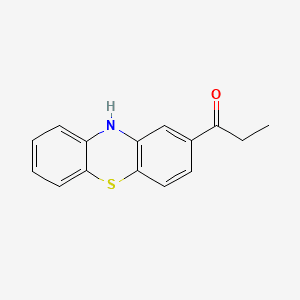

2-Propionylphenothiazine (CAS 92-33-1), chemically known as 1-(10H-phenothiazin-2-yl)propan-1-one, is a vital sulfur-nitrogen heterocyclic building block. In Elemental Derivatives hierarchy (Nitrogen/Sulfur Heterocycles path), it serves as the foundational core for the synthesis of "typical" first-generation antipsychotics and specialized sedatives. The structural architecture - a tricyclic phenothiazine ring with a propanoyl side chain - makes it the indispensable starting material for the production of Propiomazine and Butaperazine. For CDMOs and Bulk Pharmaceutical Manufacturers, this intermediate is a high-value "drug-linkable" node, where N-alkylation at the 10-position transforms it into active pharmacological agents. We are a globally established wholesale phenothiazine intermediates supplier and various pharmaceutical APIs, intermediates, excipients, finished formulations, and dosages from sourcing, r&d to manufacturing scaling through comprehensive regulatory documentation (CoA), compliances, traceability, and consistent worldwide supply capabilities, ensuring reliable lead times and quality assurance across all grades.

2-Propionylphenothiazine (CAS 92-33-1), chemically known as 1-(10H-phenothiazin-2-yl)propan-1-one, is a vital sulfur-nitrogen heterocyclic building block. In Elemental Derivatives hierarchy (Nitrogen/Sulfur Heterocycles path), it serves as the foundational core for the synthesis of "typical" first-generation antipsychotics and specialized sedatives. The structural architecture - a tricyclic phenothiazine ring with a propanoyl side chain - makes it the indispensable starting material for the production of Propiomazine and Butaperazine. For CDMOs and Bulk Pharmaceutical Manufacturers, this intermediate is a high-value "drug-linkable" node, where N-alkylation at the 10-position transforms it into active pharmacological agents. We are a globally established wholesale phenothiazine intermediates supplier and various pharmaceutical APIs, intermediates, excipients, finished formulations, and dosages from sourcing, r&d to manufacturing scaling through comprehensive regulatory documentation (CoA), compliances, traceability, and consistent worldwide supply capabilities, ensuring reliable lead times and quality assurance across all grades.
Pharmaceutical
Pharmaceutical Actives & Precursors
Intermediates & Precursors

Chemical Properties & Specifications
Acute Tox. 4 (50%), Skin Irrit. 2 (66.7%), Eye Irrit. 2A (83.3%), STOT SE 3(83.3%)
P261, P264, P264+P265, P270, P271, P280, P301+P317, P302+P352, P304+P340, P305+P351+P338, P319, P321, P330, P332+P317, P337+P317, P362+P364, P403+P233, P405, and P501
Condensed with 2-dimethylaminoisopropyl chloride in the presence of a strong base (like NaN H2 or KOH ) to yield the Propiomazine base
Industrial routes focus on minimizing isopropiomazine impurities by controlling regioselectivity during the 10-position alkylation
Labs' preference as a reference standard to detect unreacted intermediates or degradation products in finished phenothiazine dosages
Critical for validating HPLC/LC-MS methods under ICH guidelines for "process-related impurities"
Research-grade explored in the synthesis of organic photocatalysts due to the electron-rich nature of the sulfur-nitrogen tricyclic system.
MOA: Acts primarily as a potent Hi receptor antagonist and a dopaminergic/serotonergic blocker
Clinical Indications: Short-term treatment of insomnia, as a pre-surgical sedative to relieve anxiety, and as an adjunct to analgesics during labour.
MOA: High-potency Dz receptor antagonist in the mesolimbic pathway
Clinical Indications: Management of Schizophrenia and acute manic episodes in bipolar disorder.