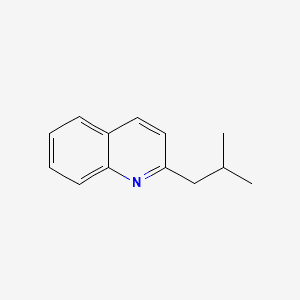


2-(2-Methylpropyl)quinoline, commonly known in the aroma industry as Isobutyl Quinoline (IBQ), is a powerful nitrogen-based heterocycle and a legendary "character" ingredient in perfumery and pharmaceutical synthesis. 2-Isobutylquinoline (CAS 93-19-6) is the structurally defined, high-purity version of the quinoline family. While its "mixture" cousin (CAS 1333-53-5) dominates the fragrance market, the 93-19-6 isomer is the essential building block for targeted molecular engineering. Within the Elemental Derivatives (Nitrogen/Quinoline path), this molecule represents the refinement of coal tar or synthetic pyridine derivatives into high-value speciality chemicals. alpha-Isobutylquinoline is famous for its intense “leather” and "castoreum" odour profile with mossy, earthy nuances. Beyond its dominance in fine fragrance, IBQ serves as a critical scaffold for CDMOs and medicinal chemists developing CNS-active agents and antimicrobial coatings. By offering an "Exclusive Grade" with high isomeric purity, we ensure that the harsh, metallic notes of lower-quality quinolines are eliminated, leaving only the sophisticated, animalic depth required for luxury formulations and precision chemistry. We are a globally established bulk pure IBQ supplier and various other aroma chemical manufacturer worldwide through comprehensive regulatory documentation (CoA), traceability, and consistent global supply capabilities, ensuring reliable lead times and quality assurance across all grades.

2-(2-Methylpropyl)quinoline, commonly known in the aroma industry as Isobutyl Quinoline (IBQ), is a powerful nitrogen-based heterocycle and a legendary "character" ingredient in perfumery and pharmaceutical synthesis. 2-Isobutylquinoline (CAS 93-19-6) is the structurally defined, high-purity version of the quinoline family. While its "mixture" cousin (CAS 1333-53-5) dominates the fragrance market, the 93-19-6 isomer is the essential building block for targeted molecular engineering. Within the Elemental Derivatives (Nitrogen/Quinoline path), this molecule represents the refinement of coal tar or synthetic pyridine derivatives into high-value speciality chemicals. alpha-Isobutylquinoline is f...

Chemical Properties & Specifications
H411, H333, H320, H315, H302
Gold standard for creating authentic leather, suede, and tobacco notes in masculine and unisex fine fragrances
Powerful fixative, anchoring more volatile top notes and providing a long-lasting, sophisticated dry-down
Privileged scaffold used by scientists to design molecules for Alzheimer’s research and anti-plasmodial activity
Synthesis of specialized ligands for transition-metal catalysis and molecular imaging probes
Ability to form protective films on metal surfaces in acidic environments, particularly in high-temperature oil and gas extraction in Industrial & Metallurgy applications
Extractants in the separation of heavy metals from ores. The 2-position substitution prevents unwanted complexation with smaller, non-target ions
Scaffold for molecules targeting Type 2 Diabetes and various bacterial infections
Precursor for chiral ligands where the spatial orientation of the isobutyl group at the 2-position is mandatory for catalyst efficiency
As a specialty nitrogen heterocycle, it is classified under HSN 2933.49. We maintain a "buffer stock" for our B2B partners to mitigate the volatility often seen in quinoline feedstocks. Our Exclusive Grade ensures consistent color and odor profiles, reducing the need for costly batch-to-batch re-evaluations.
Our process utilizes selective alkylation to ensure that the 2-position is highly favored. We provide a detailed GC-MS profile showing 99% purity, specifically monitoring and limiting the presence of other methyl/propyl quinoline isomers that can act as catalyst poisons in downstream synthesis.
2-Isobutylquinoline is highly lipophilic. It is miscible with most organic solvents (Alcohol, Benzyl Benzoate, DEP, and fixed oils) but remains practically insoluble in water. This makes it an excellent candidate for phase-transfer catalysis or hydrophobic API development.
Nitrogen heterocycles naturally darken over time. To ensure "Fresh-from-Plant" quality, we pack under an Inert Nitrogen Blanket in UV-protected containers. For procurement managers, we recommend a 12-month re-test cycle to maintain peak sensory and chemical specifications.
No. While they share the same name in common parlance, 93-19-6 is a single isomer with a defined boiling point and reactivity. 1333-53-5 is a mixture. If you supply the mixture to an R&D lab, their chemical reactions will likely fail or produce unwanted byproducts.
We utilize high-resolution (GC) to ensure that the 2-isomer constitutes ≥ 99% of the total alkylquinoline content. We provide the GC trace as part of our COA to verify that the steric profile is consistent for your coupling reactions.
The isobutyl group at the 2-position slightly increases the basicity of the nitrogen atom due to the inductive effect (+I), though the steric bulk of the isobutyl group can make the nitrogen less accessible for certain bulky Lewis Acids.
Yes export ready with 2-(2-Methylpropyl) quinoline coa, 2-(2-Methylpropyl) quinoline sds with other export documents, manufacturing compliances adhering local regulations.