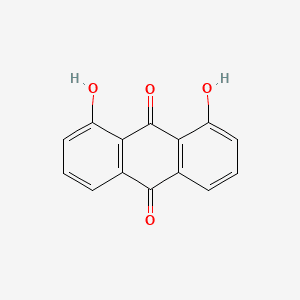

1,8-Dihydroxyanthraquinone, commonly known as Danthron or Chrysazin, is a naturally occurring dihydroxylated anthraquinone derivative that occupies a significant niche in both therapeutic medicine and industrial organic synthesis. Structurally related to the bioactive aglycones found in botanical laxatives like Senna and Rhubarb, it has been traditionally utilized as a stimulant laxative that increases the motility of the large intestine. Beyond its clinical history, it serves as a vital organic intermediate for the production of diverse vat dyes and pigments, where its specific phenolic arrangement allows for complex molecular coupling. In modern chemical research, it is valued as a scaffold for developing DNA-binding agents and fluorescent probes due to its planarity and unique electronic properties. By adhering to rigorous purity standards, 1,8-Dihydroxyanthraquinone enables the precise synthesis of high-value colorants and pharmaceutical research molecules.

1,8-Dihydroxyanthraquinone, commonly known as Danthron or Chrysazin, is a naturally occurring dihydroxylated anthraquinone derivative that occupies a significant niche in both therapeutic medicine and industrial organic synthesis. Structurally related to the bioactive aglycones found in botanical laxatives like Senna and Rhubarb, it has been traditionally utilized as a stimulant laxative that increases the motility of the large intestine. Beyond its clinical history, it serves as a vital organic intermediate for the production of diverse vat dyes and pigments, where its specific phenolic arrangement allows for complex molecular coupling. In modern chemical research, it is valued as a scaffold for developing DNA-binding agents and fluorescent probes due to its planarity and unique electronic properties. By adhering to rigorous purity standards, 1,8-Dihydroxyanthraquinone enables the precise synthesis of high-value colorants and pharmaceutical research molecules.
Pharmaceutical
Pharmaceutical Actives & Precursors
Active Pharmaceutical Ingredients (APIs)

Chemical Properties & Specifications
H351 (96%): Suspected of causing cancer [Warning Carcinogenicity
P203, P280, P318, P405, and P501
Clinical settings to treat constipation, particularly in palliative care, by stimulating the myenteric plexus to increase peristalsis
KSM for the synthesis of anthracycline-like compounds and DNA-intercalating agents studied for their potential anti-tumor activity
Development of specialized fluorescent chemosensors for detecting metal ions in biological systems
Serves as a critical precursor for the synthesis of alizarin-type dyes and other high-fastness organic pigments used in the textile and plastics industrieS
Laboratory settings for the detection of aluminum and other beryllium-group metals due to its chelating properties
Specialized electrochemical processes to modify electrode surfaces for research in energy storage
Store in a cool, dark, and dry area (15-25°C)
Keep away from strong oxidizing agents
Exposure to direct light can cause degradation of the crystalline structure and darkening of the color