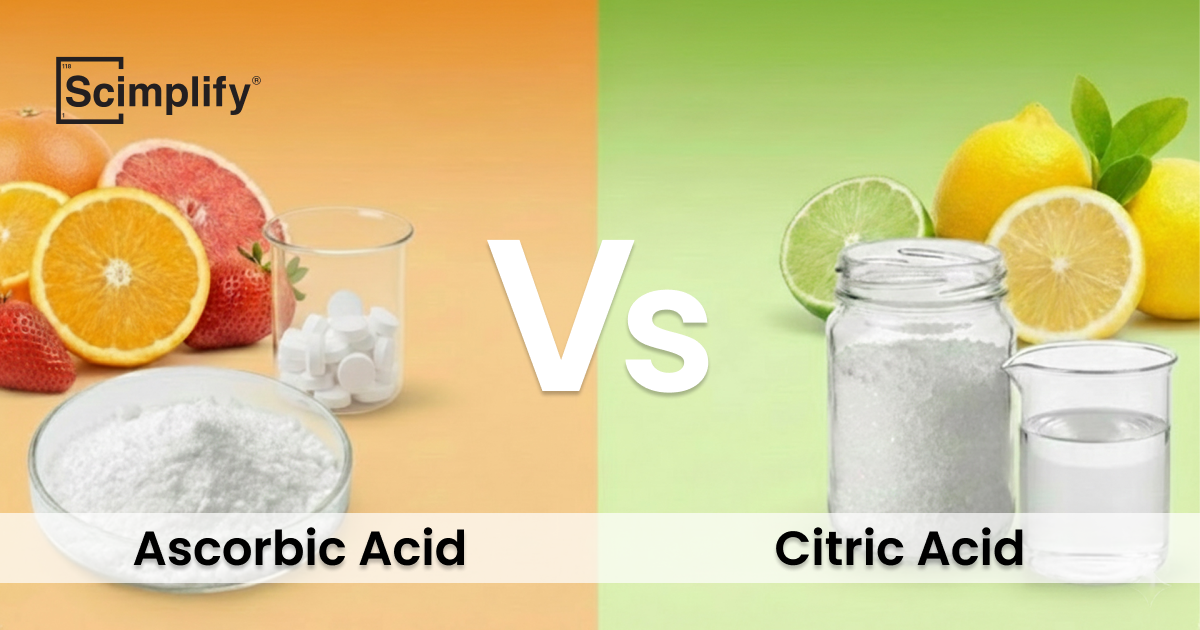
Most consumers recognize citric acid and ascorbic acid from food and supplement labels. But for formulators, these ingredients are more than familiar terms. They are functional molecules with completely different chemical identities and performance behaviors. Because of this, the comparison Ascorbic acid vs citric acid often comes up in formulation meetings, stability discussions, and regulatory reviews.
Understanding what separates these two acids is essential for correct dosing, stability design, flavor management, and compliance.
At Scimplify, we help manufacturers navigate these distinctions so they can select the acid that delivers the right chemistry and the right outcome for their product.
What Is Citric Acid?
Citric acid is a weak organic acid with the formula C6H8O7, naturally found in citrus fruits but commercially produced through fermentation of sugars using Aspergillus niger.
Its chemical structure contains three carboxyl groups, making it a tricarboxylic acid from the same family of molecules used in the Krebs cycle.
Key functional roles
- pH adjustment
- Flavor contribution
- Preservation
- Chelation
Major applications
- Soft drinks, RTD beverages
- Candies, jams
- Shampoos and personal care pH systems
- Effervescent tablets and syrups
- Cleaners and descalers
Because of these roles, citric acid is widely referenced in Ascorbic acid vs citric acid comparisons, where acidity control is the primary concern.
Access a High-Purity Citric Acid. Request a Sample!
What Is Ascorbic Acid?
Ascorbic acid (C6H8O6) is vitamin C - an essential micronutrient with strong reducing (antioxidant) properties. Its lactone ring structure donates electrons, protecting products from oxidative degradation.
Biological functions
- Collagen formation
- Immune function
- Energy metabolism
- Antioxidant defense
Key functional roles
- Antioxidant
- Nutrient fortifier
- Color retention
- Stabilizer
Applications
- Fortified foods and beverages
- Vitamin tablets and nutraceuticals
- Skincare serums
- Meat preservation
This makes ascorbic acid crucial when the formulation decision revolves around nutrition and oxidation - another major point in Ascorbic acid vs citric acid evaluations.
Request a Vitamin-Grade Ascorbic Acid Sample Today!
Citric Acid vs Ascorbic Acid: The Real Differences
Although they appear together in citrus fruits, their chemistry diverges sharply. This section clarifies the core aspects behind Ascorbic acid vs citric acid differences.
1. Chemical Identity
- Citric Acid – C6H8O7, tricarboxylic acid, highly acidic
- Ascorbic Acid – C6H8O6, lactone-based vitamin with redox activity
2. Acidity and pH Control
- Citric acid sharply lowers pH.
- Ascorbic acid is mildly acidic and cannot reliably acidify food for safety.
3. Functional Purpose
- Citric acid: sourness, pH control, chelation
- Ascorbic acid: antioxidant protection, nutrition, color retention
4. Nutritional Value
- Ascorbic acid is essential
- Citric acid has no nutritional function
5. Industrial Role
- Citric acid: low-cost acidity regulator
- Ascorbic acid: higher-value antioxidant and fortifier
Misusing one in place of the other can create stability failures or regulatory non-compliance - a key lesson in Ascorbic acid vs citric acid formulation decisions.
Request a Quote for Ascorbic Acid Today!
How Scimplify Helps You Choose the Right Acid
At Scimplify, we support formulation teams by providing:
High-purity ingredient sourcing
- Food-grade and pharma-grade ascorbic acid
- Food-grade, cosmetic-grade, industrial-grade citric acid
- COA and MSDS document support
Technical formulation guidance
- Preservative system selection
- pH adjustment design
- Antioxidant system development
- Ingredient compatibility checks
Application-specific insights
- Fortify a beverage → Ascorbic acid
- Increase sourness or adjust pH → Citric acid
- Prevent fruit browning → Ascorbic acid
- Improve metal stability → Citric acid
- Add nutritional value → Ascorbic acid
We help you apply the right principles behind Ascorbic acid vs citric acid so your formulation remains stable, safe, and compliant.
Looking for citric acid? Request a Quote
Examples From Real Formulation Scenarios
Food & Beverage
- A juice brand uses ascorbic acid to prevent oxidation.
- A soda manufacturer uses citric acid for tartness and pH control.
Cosmetics
- Ascorbic acid is used in antioxidant serums.
- Citric acid balances pH in shampoos.
Pharma
- Ascorbic acid stabilizes effervescents.
- Citric acid supports effervescence and flavor.
Cleaning
- Citric acid removes mineral deposits.
- Ascorbic acid is not used.
Conclusion: Two Acids, Two Very Different Roles
Citric acid and ascorbic acid may appear side by side on labels, but they serve completely different chemical and industrial purposes. Choosing incorrectly can compromise performance, stability, and safety.
At Scimplify, we help manufacturers source and use these acids correctly with full technical support and documentation.
For formulation assistance, write to us at info@scimplify.com.
Our team will help you apply the chemistry behind Ascorbic acid vs citric acid accurately to your product line.