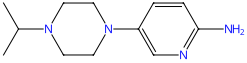

Our Trilaciclib API intermediate portfolio offers high-performance building blocks for the synthesis of the first-in-class, FDA-approved CDK4/6 inhibitor designed to protect bone marrow during chemotherapy. Trilaciclib (a kinase inhibitor used to reduce chemotherapy-induced myelosuppression) requires high-purity building blocks. Trilaciclib Advanced Intermediate 1 (CAS 2170746-95-7) & Trilaciclib Spiro-Core 2 (CAS 866620-36-2) represent critical milestones in the convergent synthesis of the spiro-pyrazino-pyrrolo-pyrimidine scaffold. Int -1 is synthesized through the condensation of 2-(methylthio)-7H-pyrrolo[2,3-d]pyrimidine-6-carboxylic acid and 1-aminomethyl-1-cyclohexanol. Int - 2 is then produced via a base-catalyzed internal cyclization of Intermediate 1, effectively locking the spiro-cyclohexane ring into the pyrazino-pyrrolo-pyrimidine framework. This "protection-free" methodology is preferred in 2026 for its high atom economy and reduced step-count compared to the original research routes. We utilise advanced spirocyclic construction and regioselective amination protocols to ensure these intermediates meet the stringent impurity profiles required for GMP-compliant drug substance manufacturing. Our manufacturing infrastructure is engineered for process safety and scalability, delivering high-purity solids with consistent (PSD). We are established global Trilaciclib intermediates supplier at 99%+ purity, ensuring minimal carry-over of methylthio-related impurities in the final API, and a broad range of various pharmaceutical intermediates for API manufacturers and semi-finished formulation suppliers, providing comprehensive analytical (HPLC/NMR/MS) and supporting quality assurance documentation (COA/TDS/SDS) across all grades, detailed impurity mapping; and region-specific regulatory support. We ensure reliable lead times from R&D quantities through commercial-scale manufacturing, enabling partners to meet diverse global and regional requirements.

Monocrotophos 36% SL
Alphacypermethrin 36% EC
Acid Yellow 36
Pigment Orange 36
Tamarind Paste (36 Brix)
Pigment Green 36
P-ANISIDINE 3,6 DISULFONIC ACID
2,2'-Azobis[2-(2-imidazolin-2-yl)propane]
2,6 dichlorofluorobenzene
2,6 Xylidine
2,2-Dibromopropane
2,2-Dimethoxypropane
2,2-Dipyrimidinedisulfide
2-Azabicyclo[2.2.2]octan-3-one
2,6 DCP
Bicyclo[2.2.2]octan-2-one
2,2'-Azobis(2,4-dimethylvaleronitrile)
2,2-Azobis(2-amidinopropane)dihydrochloride
2-(2-Bromophenyl)propan-2-ol
2-(2-(2,2,2-Trifluoroethoxy)phenoxy) -ethyl methanesulfonate
2,2-Dibromo-2-cyanoacetamide
2,2'-Azobis(2-methylpropionitrile)
2,2,2-Trifluoroethyl Trifluoroacetate
2,2'-Azobis[2-(2-imidazolin-2-yl)propane]dihydrochloride
2,2'-Dipyridyl
2,2'-Dithiodianiline
2,2,2-Trichloro ethanol
2-Ethylbut-2-enal
2-Naphthalenethiol(2NSH)
2-Propenoic acid,2-methyl-,2-(dimehylamino)ethyl ester,polymer with 2-hydroxyethyl2-methyl-2-propenoate and 2-mehtylpropyl 2-propenoate
2,2'-Azobis[2-methyl-N-(2-hydroxyethyl)propionamide
2-Propenoic acid,2-methyl-,polymer with butyl 2-propenoate,cyclohexyl2-methyl-2-propenoate,2-hydroxyethyl 2-methyl-2-propenoate and methyl 2-methyl-2-propenoate
Fexo 2 (2-Methyl-2-Phenyl Propyl Acetate)
2-Propenoic acid, 2-methyl-, polymer with butyl 2-methyl-2-propenoate, butyl 2-propenoate, 2-hydroxyethyl 2-methyl-2-propenoate and methyl 2-methyl-2-propenoate
2-Acetylbutyrolactone (2ABL)
2-Bromo-2-methylpropane
2,6 Dichloro Benzaldehyde
2-(2-Methylpropyl) quinoline
2-Chloro-2-methylpropane
2-(4-(2-hydroxyethyl)phenyI)-2-Methylpropanoic
2-Propenoic acid,2-methyl-,butyl ester,polymer with 2-(dimethylamino)ethyl2-methyl-2-propenoate,2-hydroxyethyl 2-methyl-2-propenoate and methyl 2-methyl-2-propenoate
2-Propenoic acid,2-methyl-,polymer with butyl 2-methyl-2-prepenoate,ethenylbenzene,2-hydorxyethyl 2-methyl-2-propennoate and methyl 2-methyl-2-propenoate
(2) 2-Chloro EthylAmine Hydrochloride
2-Ethylhexyl 2-Ethylhexylphosphonic acid
2,6 Dimethoxy Phenol
2-Propenoic acid,2-methyl-,2-hydroxythyl ester,polymer with 2-ethylhexyl 2-propenoate,methyl2-methyl-2-propenoate and 2-propenoic acid
Benzene, ethenyl-, polymer with butyl 2-propenoate, 2-hydroxyethyl 2-methyl-2-propenoate, methyl 2-methyl-2-propenoate, 2-propenamide and 2-propenenitrile
2-Propenoic acid,2-methyl-,2-hydroxyethyl ester,polymer with2-ethylhexyl 2-propenoate,methyl 2-methyl-2-propenoate and 2-propenoic acid
2,2-methylenesuccinyl dichloride
Our Trilaciclib API intermediate portfolio offers high-performance building blocks for the synthesis of the first-in-class, FDA-approved CDK4/6 inhibitor designed to protect bone marrow during chemotherapy. Trilaciclib (a kinase inhibitor used to reduce chemotherapy-induced myelosuppression) requires high-purity building blocks. Trilaciclib Advanced Intermediate 1 (CAS 2170746-95-7) & Trilaciclib Spiro-Core 2 (CAS 866620-36-2) represent critical milestones in the convergent synthesis of the spiro-pyrazino-pyrrolo-pyrimidine scaffold. Int -1 is synthesized through the condensation of 2-(methylthio)-7H-pyrrolo[2,3-d]pyrimidine-6-carboxylic acid and 1-aminomethyl-1-cyclohexanol. Int - 2 is then...
Pharmaceutical
Pharmaceutical Actives & Precursors
Intermediates & Precursors
.7767eb0f.png)

Chemical Properties & Specifications
Skin Irrit. 2 (100%), Eye Irrit. 2 (100%), STOT SE 3 (100%)
P261, P264, P264+P265, P271, P280, P302+P352, P304+P340, P305+P351+P338, P319, P321, P332+P317, P337+P317, P362+P364, P403+P233, P405, and P501
CDK4/6 Inhibitor Synthesis: These intermediates are fundamental to constructing the complex spiro-structure of Trilaciclib, ensuring the correct spatial orientation for kinase binding. Oncology Drug Discovery: Essential for medicinal chemists developing next-generation myeloprotection agents and small-molecule inhibitors. Trilaciclib 1 & 2 intermediates are fundamental to constructing the complex spiro-structure of Trilaciclib, ensuring the correct spatial orientation for kinase binding Supply Chain De-risking: Our backward-integrated manufacturing ensures a steady supply of Int-1, reducing the complexity of multi-step API synthesis for pharmaceutical manufacturers.
Essential for medicinal chemists developing next-generation myeloprotection agents and small-molecule inhibitors
Int-2 serves as the reactive chlorinated scaffold ready for palladium-catalysed cross-coupling or nucleophilic aromatic substitution (SNAr)
Our backward-integrated manufacturing ensures a steady supply of Int-1, reducing the complexity of multi-step API synthesis for pharmaceutical manufacturers