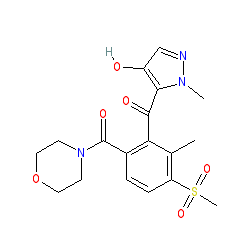

Topramezone technical is a selective post-emergence herbicide in the pyrazolone class, primarily used to control broadleaf and grass weeds in corn, soy, and other cereal crops. Topramezone Herbicides inhibit the enzyme 4-hydroxyphenylpyruvate dioxygenase (HPPD), disrupting carotenoid biosynthesis in target plants. This results in bleaching and subsequent necrosis of the weeds. The other identifier is UNII: W4934JAQ65 for the international herbicide trade. Scimplify is a trusted Topramezone Technical manufacturer in the USA, delivering formulation-ready technical material through a robust manufacturing process. Our Topramezone Technical Active is supported by complete quality documentation, including Certificates of Analysis (CoA) and EPA (FIFRA) compliance support, ensuring suitability for regulated herbicide formulations. We provide reliable lead times and competitive pricing (USD) to support long-term sourcing and supply stability for crop protection programs across the United States.


Topramezone technical is a selective post-emergence herbicide in the pyrazolone class, primarily used to control broadleaf and grass weeds in corn, soy, and other cereal crops. Topramezone Herbicides inhibit the enzyme 4-hydroxyphenylpyruvate dioxygenase (HPPD), disrupting carotenoid biosynthesis in target plants. This results in bleaching and subsequent necrosis of the weeds. The other identifier is UNII: W4934JAQ65 for the international herbicide trade. Scimplify is a trusted Topramezone Technical manufacturer in the USA, delivering formulation-ready technical material through a robust manufacturing process. Our Topramezone Technical Active is supported by complete quality documentation, i...
Agrochemicals
Crop Protection & Pest Control
Herbicides
.7767eb0f.png)

Chemical Properties & Specifications
Reproductive Toxicity: Category 1B, Hazardous to the Aquatic Environment (Acute): Category 1, Hazardous to the Aquatic Environment (Chronic): Category 1
H360: May damage fertility or the unborn child, H400: Very toxic to aquatic life, H410: Very toxic to aquatic life with long-lasting effects.
P201: Obtain special instructions before use, P202: Do not handle until all safety precautions have been read and understood, P273: Avoid release to the environment, P280: Wear protective gloves and eye/face protection, P308+P313: IF exposed or concerned: Get medical advice/attention. P391: Collect spillage. P405: Store locked up. P501: Dispose of contents/container in accordance with local regulations.
Post-emergence in corn crops to control a wide range of broadleaf and grass weeds.
Healthy crop development by eliminating competitive weed species.
Store at room temperature (typically 15–30°C or 59–86°F).
Store in a cool, dry, and well-ventilated area, away from sources of ignition, direct sunlight, and incompatible materials such as strong oxidizing agents.
Keep in original, tightly sealed containers to prevent contamination, degradation, and moisture absorption.
Available in 1 kg, 5 kg, 10 kg, and 25 kg containers. Custom packaging can be provided upon request to meet specific requirements.
Topramezone is a selective herbicide used post-emergence to control broadleaf and grass weeds in crops like corn.
It inhibits the enzyme 4-hydroxyphenylpyruvate dioxygenase (HPPD), disrupting carotenoid biosynthesis in target plants, leading to bleaching and death of the weeds.
When used as directed, Topramezone has low toxicity to mammals. However, it is classified as a reproductive toxin (Category 1B), so appropriate precautions should be taken during handling and application.
Yes, it can be tank-mixed with other compatible herbicides to broaden the spectrum of weed control. Always refer to the manufacturer's guidelines for specific mixing instructions.
It is primarily used in corn (field corn, sweet corn, and popcorn) to manage various weed species.
Topramezone is very toxic to aquatic life with long-lasting effects. Avoid application near water bodies and ensure proper measures to prevent runoff.
As with any herbicide, repeated use of Topramezone alone can lead to the development of resistant weed populations. It is advisable to use it as part of an integrated weed management program, rotating with herbicides of different modes of action.