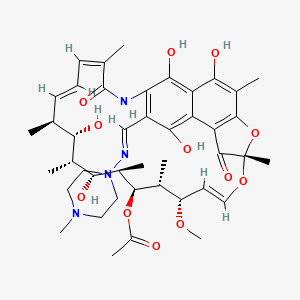

Rifampicin

Rifampicin

CAS Number
13292-46-1
Molecular Formula
C43H58N4O12
IrritantIrritant
Target Host: Amycolatopsis mediterraneiCDMO Stage: Fermentation Intermediate → Semisynthetic Processing

About Rifampicin

Rifampicin (Rifampin USP), CAS 13292-46-1, is a semisynthetic rifamycin antibiotic derived from rifamycin SV, a fermentation product of Amycolatopsis rifamycinica (C₄₃H₅₈N₄O₁₂, MW 822.94 g/mol). It is a red-orange to brown-red crystalline powder, also known as Rifampicine, and it is used by manufacturers of oral solid ...

Synonyms

  • Ramp
  • Benemycin
  • Rifater
  • null
  • Rifamate

Rifampicin Specifications

CAS Number
13292-46-1
Molecular Formula
C43H58N4O12
Molecular Weight
822.9 g/mol
IUPAC NameORBotanical Name
[(7S,9E,11S,12R,13S,14R,15R,16R,17S,18S,19E,21Z)-2,15,17,27,29-pentahydroxy-11-methoxy-3,7,12,14,16,18,22-heptamethyl-26-[(E)-(4-methylpiperazin-1-yl)iminomethyl]-6,23-dioxo-8,30-dioxa-24-azatetracyclo[23.3.1.14,7.05,28]triaconta-1(29),2,4,9,19,21,25,27-octaen-13-yl] acetate
Canonical SMILES
C[C@H]1/C=C/C=C(\C(=O)NC2=C(C(=C3C(=C2O)C(=C(C4=C3C(=O)[C@](O4)(O/C=C/[C@@H]([C@H]([C@H]([C@@H]([C@@H]([C@@H]([C@H]1O)C)O)C)OC(=O)C)C)OC)C)C)O)O)/C=N/N5CCN(CC5)C)/C
InChI Key
JQXXHWHPUNPDRT-WLSIYKJHSA-N
InChI
InChI=1S/C43H58N4O12/c1-21-12-11-13-22(2)42(55)45-33-28(20-44-47-17-15-46(9)16-18-47)37(52)30-31(38(33)53)36(51)26(6)40-32(30)41(54)43(8,59-40)57-19-14-29(56-10)23(3)39(58-27(7)48)25(5)35(50)24(4)34(21)49/h11-14,19-21,23-25,29,34-35,39,49-53H,15-18H2,1-10H3,(H,45,55)/b12-11+,19-14+,22-13-,44-20+/t21-,23+,24+,25+,29-,34-,35+,39+,43-/m0/s1
UNII Code
VJT6J7R4TR
ChEBI ID
CHEBI:28077
DSSTox Substance ID
DTXSID6021244
EINECS Number
236-312-0
Molecular Weight
822.9 g/mol
XLogP3
4.9
Hydrogen Bond Donor Count
6
Hydrogen Bond Acceptor Count
15
Rotatable Bond Count
5
Monoisotopic Mass
822.40512330 Da
Melting Point (Experimental)
187°C
Boiling Point (Predicted)
937.430±65.00°C Press: 760.00 Torr
Density (Predicted)
1.345±0.14 g/cm3 Temp: 25°C; Press: 760 Torr
pKa (Experimental)
2.97 (acidic)
GHS Hazard Statements
H302 (98.4%): Harmful if swallowed H315 (85.2%): Causes skin irritation H319 (85.2%): Causes serious eye irritation H335 (83.6%): May cause respiratory irritation
Hazard Classes and Categories
Acute Tox. 4 (98.4%) Skin Irrit. 2 (85.2%) Eye Irrit. 2 (85.2%) STOT SE 3 (83.6%)

First-Line Anti-Tubercular Combination Therapy

Foundational active pharmaceutical ingredient in single- and fixed-dose combination (FDC) tablets prescribed for active and latent Mycobacterium tuberculosis infections

Leprosy & Atypical Mycobacterial Regimens

A primary antimicrobial active component used in multi-drug therapy (MDT) protocols for Mycobacterium leprae and Mycobacterium avium complex (MAC) management

Severe Staphylococcal & Enterococcal Co-Therapy

A high-potency synergistic active agent combined with vancomycin or beta-lactams to treat biofilm-associated prosthetic joint and endocarditis infections

Neisseria Meningitidis Carrier Eradication

An active oral agent administered for short-course chemoprophylaxis in asymptomatic carriers of Neisseria meningitidis to prevent outbreak transmission

Bacterial RNA Polymerase Research

A high-specificity biochemical tool compound used to investigate transcription initiation kinetics, DNA-dependent RNA polymerase binding pockets, and bacterial resistance gene mutations

  1. Ramp
  2. Benemycin
  3. Rifater
  4. null
  5. Rifamate

Rifampicin FAQs

Minimum Order Quantity

25 kg (evaluation) · 1 MT (commercial)

Lead Time

3 – 5 weeks estimated

Delivery Terms

FOB*

Packaging

20 L pails, 200 L HDPE drums, 1000 L IBC

US Availability

US Facility Inventory

Documentation

US SDS · COA · TDS · Specification sheet

US Regulatory & Quality Information

TSCA status*

US SDS / HazCom*

GHS classification*

ISO 9001:2015 site*

DOT shipping classification*

FDA status*

EPA status*

California Prop 65*

Reliable US supply chain

Regulatory compliance

On-time delivery

Technical expert support

Rounded Top

Explore Biologics Portfolio

Leuprolide Acetate

CAS No 74381-53-6

Leuprolide Acetate

Category

Synthetic & Recombinant Peptides

Sub-Category

GnRH Agonists & Oligopeptides

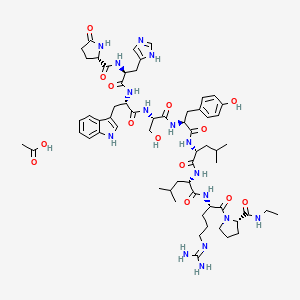
Description : Leuprolide acetate (CAS No: 74381-53-6) is a synthetic nonapeptide analogue of naturally occurring gonadotropin-releasing hormone (GnRH/LHRH) featuring a D-leucine substitution at position 6 and an N-ethylamide terminus at position 9, functioning as a high-potency LH-RH receptor agonist that down-regulates pituitary gonadotropin receptors and suppresses downstream steroidogenesis. As the international pharmaceutical sector expands beyond short-acting subcutaneous therapies toward 1-month, 3-month, and 6-month sustained-release biodegradable microspheres and subcutaneous implants, demand across oncology and reproductive endocrinology has intensified. Manufacturing facilities producing advanced parenteral therapeutics face acute quality and yield hurdles, particularly peptide chain truncation during continuous synthesis, aggregation during freeze-drying, and autocatalytic polymer cleavage induced by residual acidic reagents. Global pharmaceutical manufacturers, generic injectables formulators, and contract development organisations resolve these hurdles by sourcing through a certified commercial Leuprolide Acetate API supplier providing an active ingredient assay of ≥ 99.0% on an anhydrous, acetic acid-free basis. Sourcing high-purity leuprolide acetate active pharmaceutical ingredient with controlled trifluoroacetic acid (TFA) counter-ion levels (< 0.10%) protects polylactide-co-glycolide (PLGA) polymer matrices from premature core erosion, eliminates initial drug burst release in depot formulations, and secures long-term room-temperature stability. Every production batch undergoes comprehensive quality control testing and is supplied with batch-specific analytical dossiers confirming European Pharmacopoeia (Ph. Eur.) compliance, EU REACH registration, cGMP adherence, and WHO-GMP certification. We are an established Leuprolide Acetate API supplier with ≥ 99% purity globally for semi-finished formulators, providing comprehensive analytical (HPLC/NMR/MS) and supporting Leuprolide Acetate COA/TDS/SDS. Beyond supply, we support partners with region-specific compliances, GMP quality assurance, and regulatory documentation through global supply chain capabilities and logistics coordination.

View Product
ATS 8

CAS No 125971-94-0

ATS 8

Category

Biocatalytic & Chiral Intermediates

Sub-Category

Enzymatic & Fermentation Intermediates

Description : We supply high-purity ATS - 8 (Atorvastatin Int.) to drive commercial production and biocatalytic process innovations across the international cardiovascular pharmaceutical, APIs, CDMO bioprocessing, and fine chemical manufacturing sectors. Recognised across global biopharma supply chains as atorvastatin side chain amine, (4R-cis)-6-(2-aminoethyl)-2,2-dimethyl-1,3-dioxane-4-acetic acid tert-butyl ester, this key chiral synthon contains two stereocentres critical for constructing the enantiomerically pure 3,5-dihydroxyheptanoic acid side chain of atorvastatin calcium. Produced via multi-step enzymatic biotransformation and green biocatalytic aldolase/halohydrin dehalogenase cascades, the chiral intermediate achieves enantiomeric excess values exceeding 99.5% (ee ≥ 99.5%), drastically reducing reliance on heavy-metal resolution catalysts and hazardous organometallic reagents. Global pharmaceutical manufacturers and bioprocess operators are replacing legacy multi-step chemical resolution routes with enzymatic biotransformations, selecting our strictly controlled 99.0% minimum purity grade to prevent diastereomeric contamination and downstream API crystallisation failures. Generic pharmaceutical producers partner with us as their certified global atorvastatin intermediate supplier to protect high-volume statin manufacturing campaigns from raw material impurities and cross-border supply chain bottlenecks. Choosing us as your trusted atorvastatin side chain amine supplier guarantees an advanced bioprocess intermediate that provides excellent batch-to-batch chemical yield, low residual solvent levels, and uniform crystalline powder stability during coupling reactions. Engineering and quality assurance teams can verify our strict material metrics by downloading our batch-specific ATS - 8 COA and TDS documentation, which details precise HPLC purity, chiral optical rotation, residual heavy-metal limits (≤ 10 ppm), and particle size distributions. Accessing our official ATS - 8 TDS ensures compliance with global standards, including European REACH registration, RoHS directives, cGMP compliance, and ISO 9001 quality management rules. Partner with us as your preferred ATS - 8 supplier to lock in commercial intermediate reserves and scale your active pharmaceutical ingredient lines

View Product