
Cerium Carbonate

Cerium Carbonate

CAS Number
5853-16-7
Molecular Formula
C3Ce2O9
Cerium Oxide (CeO2) PrecursorCatalytic ComponentHigh-Purity Cerium Raw MaterialPolishing Agent PrecursorC3H2Ce2O10 (isomer)Opacifier & Therma StabiliserRRes (Rare earth metals)

About Cerium Carbonate

Cerium Carbonate (Ce₂(CO₃)₃·xH₂O) is a rare-earth carbonate compound that appears as a white to off-white crystalline powder. It serves as a versatile raw material and precursor for a wide range of cerium-based compounds, including cerium oxide, owing to its chemical stability, ease of conversion under controlled calci...

Cerium Carbonate Specifications

CAS Number
5853-16-7
Molecular Formula
C3Ce2O9
Molecular Weight
478.274
IUPAC Name
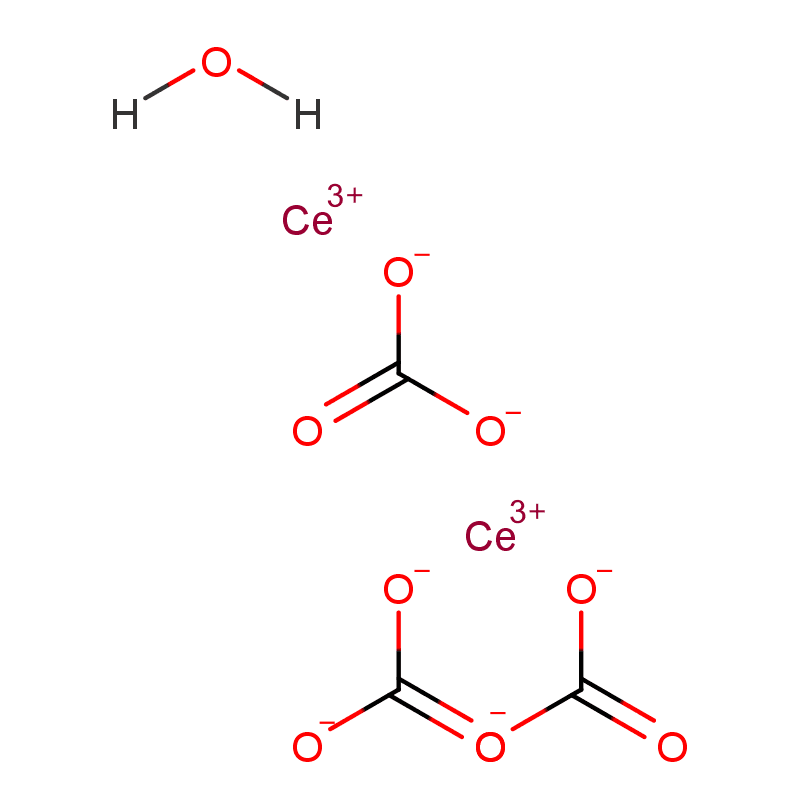
bis(cerium(3+));tricarbonate
Canonical SMILES
C(=O)([O-])[O-].C(=O)([O-])[O-].C(=O)([O-])[O-].[Ce+3].[Ce+3]
InChI Key
GHLITDDQOMIBFS-UHFFFAOYSA-H
InChI
1S/3CH2O3.2Ce/c3*2-1(3)4;;/h3*(H2,2,3,4);;/q;;;2*+3/p-6
EINECS Number
208-655-6
UNSPSC Code
12352302
HSN No
2846.10.90 or 2846.90.90
Molecular Weight
478.274
PSA
198.80
LogP
-7.40530
Boiling Point
333.6ºC at 760 mmHg
Flash Point
169.8ºC
Exact Mass
729.9236
Monoisotopic Mass
729.92360
Decomposition
mp 610°C (decomposes)
Safety & Hazard
GHS Classification Warning (GHS07) May cause skin and eye irritation May cause respiratory irritation (H315, H319, H335) Handling Requires use of PPE (dust mask type N95, gloves, eye shields) due to potential dust inhalation, ensure adequate ventilation

Glass and Optical Glass Manufacturing

Cerium Carbonate is used in the production of glass and specialty optical glass. As a rare-earth additive, it improves transparency, reduces discoloration caused by iron impurities, and enhances UV-blocking properties in glass.

Ceramics and Advanced Ceramics

Cerium Carbonate is utilized in ceramic and advanced ceramic manufacturing to enhance thermal stability, chemical resistance, and mechanical strength. For ceramics used in electronics, aerospace, or high-temperature applications, Cerium Carbonate as a raw material helps achieve desirable microstructure and performance.

Catalysts & Environmental/Emission Control

Cerium Carbonate serves as a base material for automotive exhaust catalysts and environmental and emission-control systems. After conversion to cerium oxide or mixed cerium compounds, these catalysts help reduce harmful gases such as CO and NOx, thereby supporting global environmental compliance.

Metallurgy & Alloying / Rare-Earth Alloys

In metallurgy, Cerium Carbonate is used to produce cerium-based alloys that improve properties such as oxidation resistance and thermal stability. Rare-earth alloy producers use cerium compounds derived from carbonate precursors for specialty metal applications.

Research, Fine Chemicals & Specialty Materials

Cerium Carbonate is also used as a chemical reagent and raw material in research, fine chemical synthesis, luminescent materials, and advanced materials development. Its role as a versatile rare-earth source makes it valuable for research and development and high-tech applications worldwide.

Detail 1

Store in a cool, dry place

Detail 2

Keep containers tightly closed and protected from moisture, as the hydrate form is hygroscopic

Detail 3

Strong oxidizing agents and strong acids (will cause vigorous decomposition, releasing carbon dioxide)

Cerium Carbonate FAQs

Minimum Order Quantity

25 kg (evaluation) · 1 MT (commercial)

Lead Time

3 – 5 weeks estimated

Delivery Terms

FOB*

Packaging

20 L pails, 200 L HDPE drums, 1000 L IBC

US Availability

US Facility Inventory

Documentation

US SDS · COA · TDS · Specification sheet

US Regulatory & Quality Information

TSCA status*

US SDS / HazCom*

GHS classification*

ISO 9001:2015 site*

DOT shipping classification*

FDA status*

EPA status*

California Prop 65*

Reliable US supply chain

Regulatory compliance

On-time delivery

Technical expert support

Rounded Top

Explore Critical Metals Portfolio

Manganese Sulfate Monohydrate

CAS No 10034-96-5

Manganese Sulfate Monohydrate

Category

Critical metals & Strategic materials

Sub-Category

Manganese Compounds

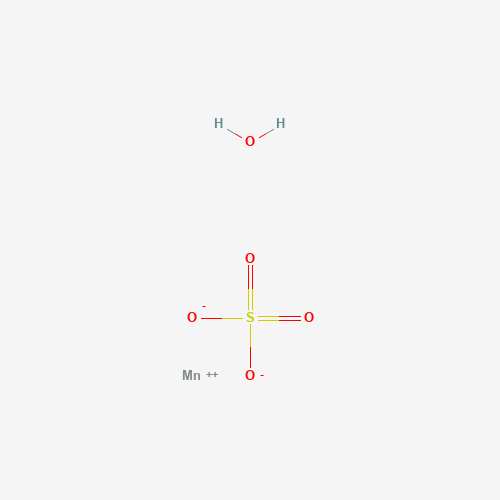
Description : Manganese Sulfate Monohydrate (CAS No: 10034-96-5), identified across chemical registers under technical names like manganese(||) sulphate monohydrate, manganous sulphate monohydrate, and sulphuric acid manganese(2+) salt monohydrate, is expanding its position as a critical inorganic metal salt across the global energy storage, agricultural micronutrient, and metallurgical chemical processing sectors. The compound features a high-purity manganese core stabilised as a pink crystalline monohydrate, serving as the essential precursor for producing high-purity manganese sulphate (HPMSM) for lithium-ion battery cathode chemistries, specifically Nickel-Manganese-Cobalt (NMC) and Lithium Iron Manganese Phosphate (LMFP) formulations. Agricultural chemical producers utilise this salt as a bioavailable micronutrient source in foliar fertilisers, soil remediation blends, and animal feed premixes to correct chlorosis and support enzyme activation. The material also serves as a key intermediate in producing electrolytic manganese metal (EMM), electrolytic manganese dioxide (EMD), fungicide active ingredients like mancozeb, and porcelain glazes. Global procurement operations prioritise suppliers offering technical, feed, and battery-grade material (≥ 98.0% to 99.9% minimum purity) with strictly controlled trace-element baselines to prevent battery cell degradation and ensure consistent agricultural performance. As an established global Manganese Sulphate Monohydrate supplier, we provide commercial allocations supported by batch-specific ICP-MS impurity tracking, CoA, and TDS documentation across international supply routes.

View Product
Ammonium paratungstate

CAS No 11120-25-5

Ammonium paratungstate

Category

Critical metals & Strategic materials

Sub-Category

Tungsten Compounds

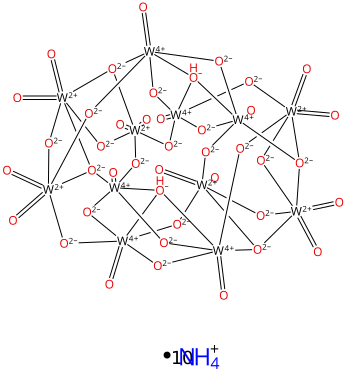
Description : Source high-purity ammonium paratungstate (CAS 11120-25-5) from Scimplify, one of the trusted global ammonium paratungstate suppliers and critical metal distributors. Ammonium Paratungstate (APT), a white crystalline ammonium tungsten salt commonly supplied as the decahydrate, is the most important intermediate in the entire tungsten industry, with the majority of global tungsten production passing through it. With a typical WO3 content of 88.5 to 89 percent, APT is the primary high-purity precursor for tungsten oxides, tungsten metal powder, and tungsten carbide.As the universal tungsten intermediate, APT is the starting point for virtually all downstream tungsten chemistry. Through calcination and chemical conversion it yields yellow and blue tungsten oxide, tungstic acid, and ammonium metatungstate (AMT), which is why buyers can source it alongside Tungsten Oxide (WO3), Tungstic Acid, and Sodium Tungstate from a single compliant global manufacturer.We supply APT in industrial grade for large-scale tungsten powder production and high-purity grades for electronics applications, with a low impurity profile and controlled crystal size that protect the grain size and yield of the final tungsten powder. As a renowned ammonium paratungstate manufacturer and supplier, our material meets global regulatory standards, including REACH (EU) registration and RMI conflict-free mineral sourcing.

View Product
Tungsten metal

CAS No 7440-33-7

Tungsten metal

Category

Critical metals & Strategic materials

Sub-Category

Tungsten Compounds

Description : Source high-purity Tungsten Metal (CAS 7440-33-7) from Scimplify, one of the trusted global tungsten metal suppliers and manufacturers. Tungsten (W), also known as wolfram, is a refractory metal with the highest melting point of any metal at around 3,410 degrees Celsius.We supply tungsten metal as high-purity powder across a range of particle sizes and apparent densities, with FSSS-controlled grades from standard purity through 99.9 percent and above for demanding electronic and aerospace applications. Particle size and purity directly determine the density, grain structure, and performance of the wire, pressed and sintered parts, and carbide produced downstream.Supplied primarily as high-purity tungsten powder, it is the metallic foundation for tungsten carbide, high-density alloys, and a wide range of electronic and high-temperature components.Tungsten metal sits at the downstream end of the tungsten value chain. It is produced by hydrogen reduction of tungsten oxide, which is itself derived from ammonium paratungstate, and it is the direct feedstock for tungsten carbide and tungsten mill products. This lets buyers source tungsten powder alongside Tungsten Carbide, Tungsten Oxide (WO3), and Ammonium Paratungstate from a single compliant global manufacturer.As a renowned tungsten metal manufacturer and supplier, our material meets global regulatory standards, including REACH (EU) registration and RMI conflict-free mineral sourcing

View Product
Bismuth metal

CAS No 7440-69-9

Bismuth metal

Category

Metal Oxides & Synergists, Critical metals & Strategic materials

Sub-Category

Metal additives, Bismuth Compounds

Description : Bismuth granular (CAS 7440-69-9) is an essential high purity fine chemical utilized in the API intermediates market for the synthesis of gastrointestinal pharmaceuticals and radiopaque agents, meeting the rigorous demands of the growing CDMO sector (Pharma/API purity 99% | General Industry purity 98%). Metallic bismuth serves as a sustainable alternative to lead in metallurgical applications and specialized alloys, benefiting from global sourcing shifts toward non-toxic bulk chemical supplier materials (Pharma/API purity 99% | General Industry purity 98%). Crystalline bismuth is increasingly sought for custom synthesis services in the semiconductor and superconductor industries, where precise regulatory compliance and impurity control are paramount for advanced electronic components (Pharma/API purity 99% | General Industry purity 98%). As globally established Bismuth metal granular supplier, we ensure dependable supply, consistent quality, and complete regulatory documentation, including CoA and TDS across all grades. Beyond supply, we support partners through the entire product lifecycle from route scouting, process and formulation development, and analytical method development to scale-up, process optimisation, and pilot-to-commercial manufacturing. Our teams also assist with GMP-compliant quality assurance, regulatory documentation, and global supply chain and logistics coordination.

View Product