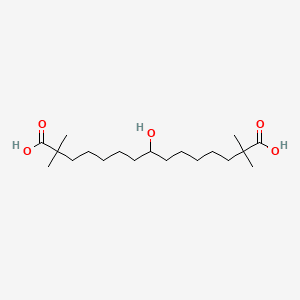

Bempedoic Acid (CAS No. 738606-46-7) is a novel lipid-lowering active pharmaceutical ingredient (API) widely used in the United States for the treatment of hypercholesterolemia and cardiovascular risk management. As a first-in-class ATP citrate lyase (ACL) inhibitor, it works upstream of statins to reduce cholesterol biosynthesis in the liver, leading to significant lowering of LDL-C levels while minimizing muscle-related side effects commonly associated with statin therapies. In the US pharmaceutical market, Bempedoic Acid is extensively utilized in oral solid dosage formulations, including both standalone therapies and fixed-dose combination drugs, particularly for patients with atherosclerotic cardiovascular disease (ASCVD) or heterozygous familial hypercholesterolemia (HeFH). Additionally, Bempedoic Acid plays a key role in combination drug development strategies and preventive cardiology programs, making it a critical API for pharmaceutical companies and CDMOs focused on advanced cardiovascular therapeutics in the United States. Scimplify is a Bempedoic Acid manufacturer and ssupplierin the USA that focuses on high-purity API production, regulatory compliance, and scalable supply to support clinical and commercial pharmaceutical applications.


Bempedoic Acid (CAS No. 738606-46-7) is a novel lipid-lowering active pharmaceutical ingredient (API) widely used in the United States for the treatment of hypercholesterolemia and cardiovascular risk management. As a first-in-class ATP citrate lyase (ACL) inhibitor, it works upstream of statins to reduce cholesterol biosynthesis in the liver, leading to significant lowering of LDL-C levels while minimizing muscle-related side effects commonly associated with statin therapies. In the US pharmaceutical market, Bempedoic Acid is extensively utilized in oral solid dosage formulations, including both standalone therapies and fixed-dose combination drugs, particularly for patients with atheroscle...
Pharmaceutical
Pharmaceutical Actives & Precursors
Active Pharmaceutical Ingredients (APIs)
.7767eb0f.png)

Chemical Properties & Specifications
Low systemic toxicity; non-carcinogenic; avoid ingestion. Not classified as hazardous under standard lab handling.
Use standard lab PPE.
Non-carcinogenic, non-mutagenic (per ICH S2(R1))
Used by US pharmaceutical companies to develop oral therapies for lowering LDL-C in patients with primary hyperlipidemia and heterozygous familial hypercholesterolemia (HeFH).
Incorporated into treatment regimens targeting patients with atherosclerotic cardiovascular disease (ASCVD), supporting long-term cardiovascular risk management in the US population.
A key API for developing therapies for patients experiencing statin-associated muscle symptoms (SAMS), a significant segment in the US healthcare market.
Extensively used in combination with other lipid-lowering agents (such as cholesterol absorption inhibitors) to enhance efficacy and patient compliance in the US prescription markets.
Integrated into preventive healthcare strategies across US clinical settings to reduce cardiovascular events and improve population health outcomes.
Utilized by US-based CDMOs and pharmaceutical manufacturers for API sourcing, formulation development, clinical trials, and commercial-scale production.
Store at 2–8 °C in a tightly sealed container; protect from moisture.
It undergoes hepatic conversion by ACSVL1 to its CoA thioester, which then inhibits ATP-citrate lyase.
Liver-specific activation prevents muscle uptake, differentiating it from statins What is its impact on LDL-C levels? Reductions of 20–25% LDL-C observed in Phase III CLEAR trials Are there any relevant drug interactions? Minimal — weak interaction with OATP/OAT; no CYP450 involvement . What are its pharmacokinetics? Tmax ~3.5 h; half-life ~21 h; steady-state achieved in ~1 week What is the solubility profile for formulation? Soluble in alcohol and phosphate buffer pH 8 but insoluble below pH 5 — key for oral dosage design"
Reductions of 20–25% LDL-C observed in Phase III CLEAR trials.
Minimal- weak interaction with OATP/OAT; no CYP450 involvement.
Tmax ~3.5 h; half-life ~21 h; steady-state achieved in ~1 week.
Soluble in alcohol and phosphate buffer pH 8 but insoluble below pH 5- key for oral dosage design.
It inhibits ACL rather than HMG-CoA reductase, offering cholesterol-lowering effects without statin-associated muscle risks.
Due to low aqueous solubility, formulations typically employ basic buffers or lipid-based carriers to enhance bioavailability.
The drug is a prodrug activated by liver-specific ACSVL1 to its CoA thioester, enabling selective hepatic action.
Minimal, as it is not metabolized via CYP450. Weak inhibition of OATP2 and OAT3 transporters is noted.
Often co-administered with ezetimibe or statins to achieve optimal LDL-C control.
Prescription-only API (Rx), non-narcotic, non-scheduled under NDPS
Category : Pharmaceutical Actives & Precursors
Sub-Category : Intermediates & Precursors
Description : P-Nitrobenzoyl Chloride (CAS 122-04-3) is a critical building block in the API intermediates market,...