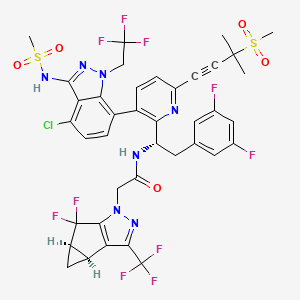

Lenacapavir Intermediate (CAS 2189684-44-2), chemically known as 6-(3-amino-2,6-difluorophenyl)-5-fluoro-1-(2,2,2-trifluoroethyl)-1H-indazole-3-carboxylic acid, is a sophisticated trifluorinated indazole scaffold. In Elemental Derivatives hierarchy (Halogen/Nitrogen Heterocycles), it represents the pinnacle of multi-step organic synthesis. This molecule is the definitive structural core of Lenacapavir (Sunlenca), a first-in-class, long-acting HIV-1 capsid inhibitor. For CDMOs and Pharma Scientists, this intermediate is critical because it contains the precise fluorine substitution pattern (five fluorine atoms across three distinct sites) required to achieve the drug's ultra-long half-life, allowing for bi-annual dosing. We are a globally established Lenacapavir Intermediate manufacturer, and supplier of various pharmaceutical APIs, intermediates, excipients, finished formulations, and dosages from sourcing, r&d to manufacturing scaling through comprehensive regulatory documentation (CoA), compliances, traceability, and consistent worldwide supply capabilities, ensuring reliable lead times and quality assurance across all grades.


Lenacapavir Intermediate (CAS 2189684-44-2), chemically known as 6-(3-amino-2,6-difluorophenyl)-5-fluoro-1-(2,2,2-trifluoroethyl)-1H-indazole-3-carboxylic acid, is a sophisticated trifluorinated indazole scaffold. In Elemental Derivatives hierarchy (Halogen/Nitrogen Heterocycles), it represents the pinnacle of multi-step organic synthesis. This molecule is the definitive structural core of Lenacapavir (Sunlenca), a first-in-class, long-acting HIV-1 capsid inhibitor. For CDMOs and Pharma Scientists, this intermediate is critical because it contains the precise fluorine substitution pattern (five fluorine atoms across three distinct sites) required to achieve the drug's ultra-long half-life, a...
Pharmaceutical
Pharmaceutical Actives & Precursors
Intermediates & Precursors
.7767eb0f.png)

Chemical Properties & Specifications
GS 6207, GS 714207, GS-CA-2, GS-HIV
Contains the 2,2,2-trifluoroethyl group and Indazole-3-carboxylic acid moiety
Multidrug-Resistant (MDR)
HIV-1 Treatment & HIV Pre-Exposure Prophylaxis (PrEP)
Disruption of HIV-1 capsid assembly and disassembly studies, Indazole core mimics natural protein-protein interface binders
Inhibits HIV-1 replication at multiple stages—including capsid-mediated nuclear uptake of proviral DNA and assembly/maturation of new progeny
Primary therapeutic use is for "Heavily Treatment-Experienced" (HTE) adults. New class-no cross-resistance with older drug classes (like INSTIs or NNRTIs)
Poly-fluorinated nature allows final drug to remain therapeutic in the body for up to 6 months after a single subcutaneous injection
Suzuki-Miyaura coupling of the indazole core with a boronic acid derivative. Favoured route for its high regioselectivity but often requires expensive palladium catalysts
Utilizes a "One-Pot" or convergent synthesis focusing on early-stage fluorination and cyclisation to reduce metal waste. Preferred route for B2B-Procurement Managers looking for cost-efficiency and "Green Chemistry" metrics
(Oncology) Potential as a GCN2 kinase inhibitor or in targeting specific growth factor pathways
(Anti-Inflammatory) Some derivatives of this scaffold show activity in inhibiting S1P receptors
Route 1 often relies on late-stage, high-cost fluorinating reagents and precious metal catalysts. Route 2 focuses on building the fluorinated indazole core from cheaper, early-stage raw materials. For B2B contracts, Route 2 offers better long-term price stability but requires more rigorous CDMO validation for isomeric purity.
2,2,2-trifluoroethyl group is highly electron-withdrawing. This reduces the basicity of the indazole nitrogen, making the molecule more resistant to metabolic oxidation. This specific modification is the "secret sauce" for the drug's 6-month dosing interval.
The most critical impurities are the des-fluoro analogs and the regioisomeric indazoles (N2-alkylation). Our Exclusive Grade utilizes specific base-catalyst pairings to ensure the N1-alkylation (Route 2) exceeds 99.5% selectivity, minimizing costly purification steps at the API stage.
While indazole-3-carboxylic acids are relatively stable, they should be stored in a cool (2-8°C), dark place under a Nitrogen blanket. Exposure to high heat and moisture can trigger slow decarboxylation, affecting the molarity of your downstream coupling reactions.
Yes Lenacapavir is export ready with Lenacapavir coa, Lenacapavir sds along with regulatory compliances.