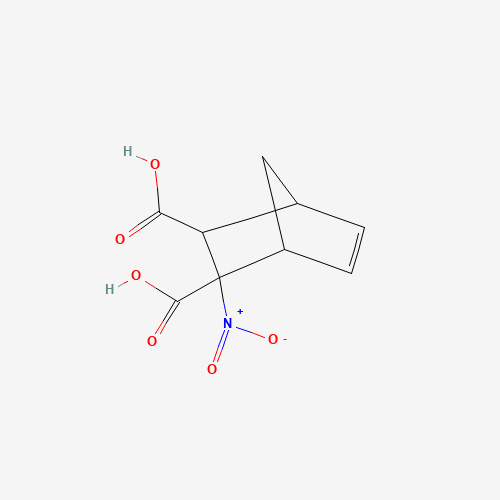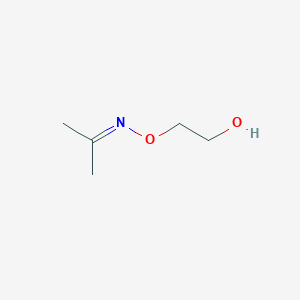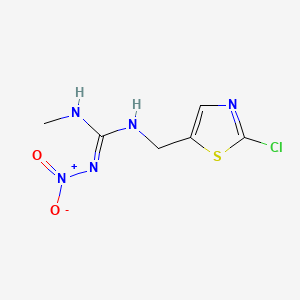
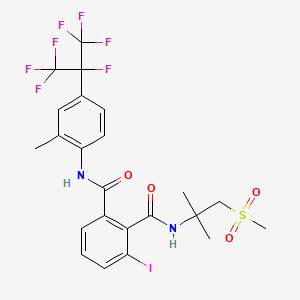

This intermediate compound serves as a critical halogenated intermediate in the multi-step synthesis of Flubendiamide which is also called (FENOS or SYNAPSE), a phthalic diamide insecticide. The structure includes an iodinated aromatic ring, a fluorinated aliphatic chain, and sulfur-containing side group — all of which contribute to the insecticidal activity in the final molecule. As a Crop Protection Agent Component, this intermediate Integrated into the production of Flubendiamide technical grade, which is further formulated into WP or SC insecticides for agriculture. On a scientific note, this molecule is strategically involved in the penultimate step of Flubendiamide synthesis, serving as a nucleophilic amide precursor that defines part of the insecticidal pharmacophore.


This intermediate compound serves as a critical halogenated intermediate in the multi-step synthesis of Flubendiamide which is also called (FENOS or SYNAPSE), a phthalic diamide insecticide. The structure includes an iodinated aromatic ring, a fluorinated aliphatic chain, and sulfur-containing side group — all of which contribute to the insecticidal activity in the final molecule. As a Crop Protection Agent Component, this intermediate Integrated into the production of Flubendiamide technical grade, which is further formulated into WP or SC insecticides for agriculture. On a scientific note, this molecule is strategically involved in the penultimate step of Flubendiamide synthesis, serving a...
Agrochemicals
Agrochemical Intermediates
Halogenated Precursors
.7767eb0f.png)

Chemical Properties & Specifications
Used in the synthesis of Flubendiamide for lepidopteran pest control. It provides structural functionality vital for targeting ryanodine receptors in insect larvae.
Its use is restricted to controlled agrochemical manufacturing sites where it is converted into Flubendiamide technical. It is not used as a standalone commercial product.
Nitro reduction or amidation under standard coupling agents (e.g., EDC, DCC)
The molecule is strategically involved in the penultimate step of Flubendiamide synthesis, serving as a nucleophilic amide precursor that defines part of the insecticidal pharmacophore.
97% (technical) to 99.5% (R&D synthesis)
25 kg HDPE drum with inner liner or nitrogen-flushed aluminum bags
Generally non-hazardous but handled under R&D category; store below 25 °C
It provides the iodo-aromatic and methylthio backbone essential for Flubendiamide’s mode of action on insect muscle function.
While primarily aligned with Flubendiamide, the structure may suit other fluorinated phthalic diamide derivatives.
Intermediate is not subject to direct residue limits but must comply with final product impurity profiles under agrochemical regulations.
It contributes the substituted nitroaryl scaffold, which forms the terminal segment of Flubendiamide. The nitro and trifluoromethyl groups are essential for maintaining high selectivity toward insect ryanodine receptors.
Yes. This intermediate typically undergoes an amide bond formation with phthalic acid halides (often iodinated), finalizing the backbone of Flubendiamide.
Yes. particularly in regulated plants. Analytical controls involve HPLC purity checks, residual solvent analysis, and nitro group validation.
Not independently, but its structural components are preserved in the final Flubendiamide molecule and are critical for biological performance.
No. The compound is structurally stable under normal synthesis and isolation conditions. Minor side-products (nitrated byproducts) are removed through crystallization or chromatography.