
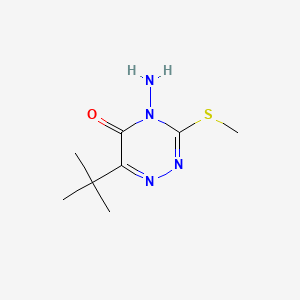
Metribuzin 480 g/L SC
Category
Crop Protection & Pest Control
Sub-Category
Herbicides
Description : Metribuzin 480 g/L SC serves as a highly selective, broad-spectrum triazinone herbicide developed specifically to eradicate tough broadleaf weeds and annual grasses in high-value solanaceous, leguminous, and perennial crops. By acting as a potent systemic interceptor within target weed seedlings, the formulation creates a clean, competitive environment for crop development. We supply high-purity Metribuzin 480 g/L SC (CAS No: 21087-64-9) to boost agricultural yield optimisation, structural weed suppression, and advanced suspension stability across global crop protection and pest control markets. Alternately recorded across international chemical indices as 4-amino-6-tert-butyl-3-methylthio-1,2,4-triazin-5(4H)-one suspension concentrate, this triazinone organic hybrid compound features a densely milled, sub-micron particle array engineered to block side-reaction formation and particle growth during large-scale FCl procurement pilot trials. Having these precise physical attributes makes this unique liquid flowable concentration the leading choice for pre-emergence and early post-emergence herbicide formulations, protecting vital potato, sugarcane, soybean, and winter cereal crops from invasive broadleaf and annual grass colonisation. As global crop science markets move away from rigid single-purpose compounds and environmentally restricted persistent herbicides, processing plants are changing their sourcing methods. Crop protection formulators are upgrading their production lines by switching exclusively to our strictly controlled 480 g/L liquid flowable grade to secure optimal structural cross-linking and eliminate batch stability material flaws like syneresis or dense bottom-caking. Large-scale formulation plants partner with us as their certified global triazinone herbicide supplier to protect their production runs from nozzle sedimentation and cross-border shipping delays. As global manufacturing standards shift toward high-shear continuous wet-milling, automated inline blending, and advanced multi-action tank mixes, choose us as your trusted liquid metribuzin supplier with Metribuzin 480 g/L SC 48% purity guarantees excellent layer-by-layer suspension uniformity and extended shelf-life intervals. Technical procurement teams can easily verify our strict material metrics by downloading our batch-specific Metribuzin 480 g/L SC COA and TDS documentation, which guarantees a precise active stoichiometry ratio, strict trace organic volatile limits, and controlled surface tension profiles. Accessing our official technical data library ensures compliance with strict global standards, including European REACH registration, universal joint FAO/WHO specification rules, and ISO 9001 quality guidelines.