Search through


Cerium Hydroxide (CeOH₃) is a voluminous, gelatinous, light-coloured precipitate that is virtually insoluble in water. Key intermediate in the Rare Earth Separation process, often serving as the initial product isolated from the ore. Industrially, Cerium (IV) oxide hydrated's primary role is as a high-purity precursor, being easily calcined (heated) to produce Cerium Oxide (CeO₂) or readily dissolved to form various Cerium salts (e.g., Cerium Nitrate). Cerium tetrahydroxide's particle morphology is critical for its use in polishing, where it is often the final precursor before drying and milling. We are a leading & trusted Cerium Hydroxide supplier in the United States and worldwide, offering high-purity Cerium Oxide that meets quality and safety standards, with reliable lead times and global supply capability.
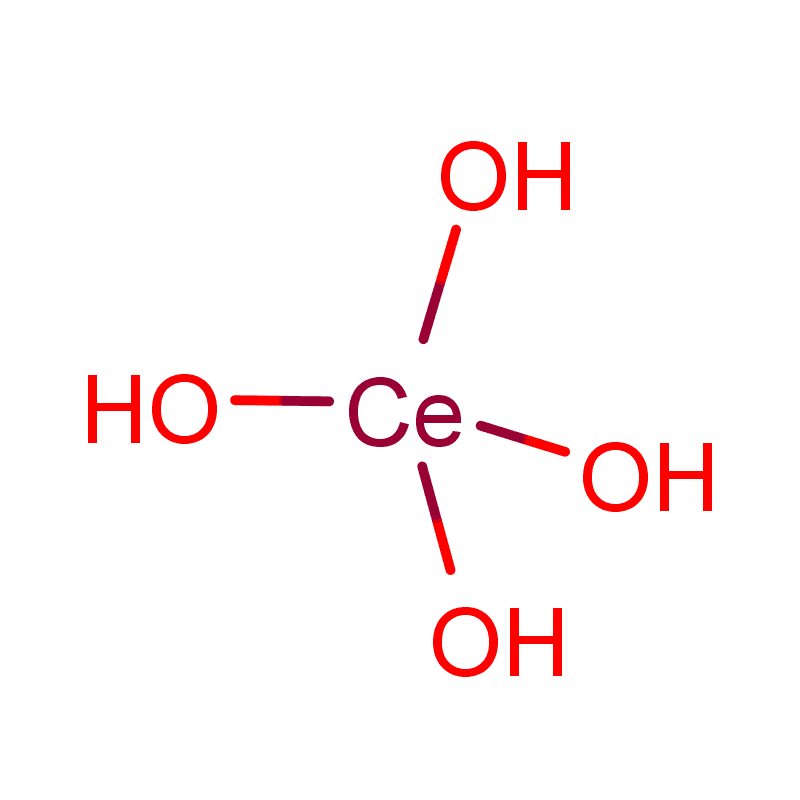
Cerium Hydroxide (CeOH₃) is a voluminous, gelatinous, light-coloured precipitate that is virtually insoluble in water. Key intermediate in the Rare Earth Separation process, often serving as the initial product isolated from the ore. Industrially, Cerium (IV) oxide hydrated's primary role is as a high-purity precursor, being easily calcined (heated) to produce Cerium Oxide (CeO₂) or readily dissolved to form various Cerium salts (e.g., Cerium Nitrate). Cerium tetrahydroxide's particle morphology is critical for its use in polishing, where it is often the final precursor before drying and milling. We are a leading & trusted Cerium Hydroxide supplier in the United States and worldwide, offerin...

.3d8f8f41.svg)
Metallurgy Chemicals
.3556d45a.svg)

Electronic & Specialty Grade Materials


Rare Earth Metals
.7767eb0f.png)

Chemical Properties & Specifications
S26
R36
Direct precursor to all grades of Cerium Oxide (CAS 1306-38-3), a process achieved through calcination (thermal decomposition)
Due to its basic nature and high surface area, utilized as a basic catalyst or catalyst support material in specific environmental and organic reactions
Сe(ОH)3 can be tailored during precipitation, making it an excellent starting material for high-performance CMP slurries and polishing powders
Used to prepare other high-purity Cerium salts (sulfates, nitrates) by reaction with the corresponding acid
Store in Ambient temperature
Inert atmosphere
Room Temperature
Naturally gelatinous and holds a significant amount of water. Selling it as a wet cake saves drying energy costs and time, making it the most economical intermediate form for shipping to nearby processing plants that will immediately dissolve or calcine it.
Primary, stable Cerium(III) hydroxide is Ce(OH)з (CAS 12014-56-1). Ce(OH)4 (Cerium( IV hydroxide) is highly unstable and rapidly dehydrates to CeO2. In practice, most researchers use Ce(OH)3 as the starting point for Ce(III) chemistry.
For Polishing, the critical specification is the Cerium content (CeO equivalent) and the morphology (particle size/shape of the Ce(OH)₃). For Catalyst Grade, the focus is ultra-high purity (4N/5N) and minimal content of praseodymium (Pr) and neodymium (Na) to avoid poisoning the final TWC catalyst.
Most basic component was isolated in early precipitation steps during the complex solvent extraction of REEs. Provides a means to selectively remove Cerium from the lighter lanthanides early in the refining process due to the ability of Ce|II to be oxidised to Ce(IV) in basic solution.
While CeOH3 is a low-toxicity solid, bulk transport of the wet cake/paste grade requires handling as an inorganic powder. The $\text{UN}$ classification focuses on its non-hazardous nature, but standard industrial hygiene practices (dust control) are essential.
No, Ce(OH)3 is not used directly. While the Cest ion will bind phosphate, the Hydroxide form is too insoluble and basic. Soluble Cerium Chloride or Cerium Sulfate salts are used instead, as they dissolve and immediately release the Cet ions required to precipitate the phosphate.