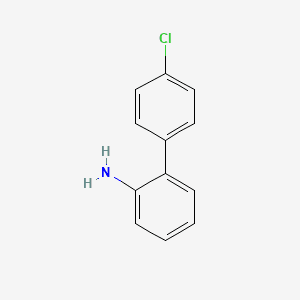

This intermediate (4-CHLOROBIPHENYL-2-AMINE.HCL) forms the biphenylamine core of Boscalid, a systemic fungicide. Features para-chlorinated phenyl ring connected to a second aromatic ring with an amino substituent. The hydrochloride salt enhances reactivity and processability in downstream coupling reactions. This intermediate is a Synthetic Precursor to Boscalid Fungicides which to be basically worked on the formulations of SC and WG fungicides for fruits, cereals, and vegetables. Contributes to fungal complex inhibition across multiple crop diseases in agriculture. It has the chemical name 4'-Chlorobiphenyl-2-amine hydrochloride.


This intermediate (4-CHLOROBIPHENYL-2-AMINE.HCL) forms the biphenylamine core of Boscalid, a systemic fungicide. Features para-chlorinated phenyl ring connected to a second aromatic ring with an amino substituent. The hydrochloride salt enhances reactivity and processability in downstream coupling reactions. This intermediate is a Synthetic Precursor to Boscalid Fungicides which to be basically worked on the formulations of SC and WG fungicides for fruits, cereals, and vegetables. Contributes to fungal complex inhibition across multiple crop diseases in agriculture. It has the chemical name 4'-Chlorobiphenyl-2-amine hydrochloride.
Agrochemicals
Agrochemical Intermediates
Aromatic Amines & Chlorinated Intermediates
.7767eb0f.png)

Chemical Properties & Specifications
It is used in the amidation or cross-coupling reaction to construct the final Boscalid structure, making it a critical upstream intermediate in the manufacture of nicotinamide-based fungicides.
Highly suitable for Suzuki and Buchwald-Hartwig reactions
≥98% (Tech. grade); R&D versions up to 99.5%
25 kg fiber drum with moisture protection liner
Non-hazardous, standard chemical transport protocols apply
Its biphenyl backbone with chlorine substitution mimics the pharmacophore of Boscalid. The ortho-amino group enables straightforward coupling to nicotinamide or heterocyclic moieties.
Yes, especially in its free base form. The hydrochloride salt is often preferred for ease of isolation but can be deprotected in situ.
It may be repurposed for other biphenylamine-based scaffolds, but its primary role remains within Boscalid synthesis due to precise substitution patterning.
No, this intermediate is fully consumed and does not appear in the final Boscalid technical unless impurity profiles are mismanaged.