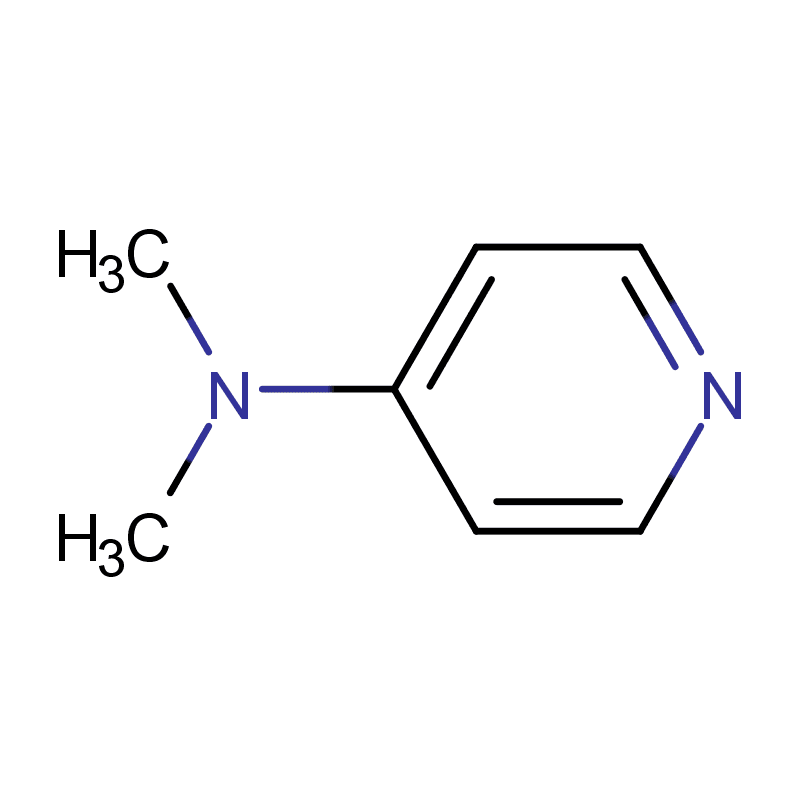

4-Dimethylaminopyridine (DMAP, CAS 1122-58-3) is a highly efficient and versatile Nucleophilic Catalyst critical for driving complex organic transformations in CDMO and fine chemical synthesis. Functioning as a derivative of pyridine, DMAP is a powerful tertiary amine base, utilised in catalytic amounts to dramatically accelerate reactions that are typically sluggish or require harsh conditions. DMAP's exceptional reactivity stems from its ability to form a highly reactive Acylpyridinium Intermediate via its high nucleophilicity at the pyridine nitrogen. This intermediate readily transfers the acyl group, thereby facilitating efficient bond formation, even with sterically hindered substrates. 4-Dimethylaminepyridine is indispensable process aid in the commercial production of a vast array of apis and complex fine chemicals. DMAP is typically supplied in high-purity (≥99%) grades suitable for synthesis. Due to its high toxicity and corrosivity, strict PPE and engineering controls (fume hood, sealed storage, specialised training) are mandatory for all handling personnel, underscoring its role as a high-potency speciality chemical. We are the leading DMAP supplier worldwide & a multiple-industry-specific Palladium grade producer, ensuring comprehensive regulatory support & CoA traceability for various grades with global supply capability with reliable lead time.


4-Dimethylaminopyridine (DMAP, CAS 1122-58-3) is a highly efficient and versatile Nucleophilic Catalyst critical for driving complex organic transformations in CDMO and fine chemical synthesis. Functioning as a derivative of pyridine, DMAP is a powerful tertiary amine base, utilised in catalytic amounts to dramatically accelerate reactions that are typically sluggish or require harsh conditions. DMAP's exceptional reactivity stems from its ability to form a highly reactive Acylpyridinium Intermediate via its high nucleophilicity at the pyridine nitrogen. This intermediate readily transfers the acyl group, thereby facilitating efficient bond formation, even with sterically hindered substrates...
Pharmaceutical, Elemental Derivatives
Excipients, Pyridine
Aminopyridines & Functionalized Pyridines, Formulation & Processing Aids
.7767eb0f.png)

Chemical Properties & Specifications
H301 (98.9%): Toxic if swallowed
H310 (70.3%): Fatal in contact with skin
H314 (32.2%): Causes severe skin burns and eye damage
H315 (59.4%): Causes skin irritation
H318 (32.8%): Causes serious eye damage
H319 (49.4%): Causes serious eye irritation
H331 (36%): Toxic if inhaled
H335 (37.9%): May cause respiratory irritation
H370 (17%): Causes damage to organs
H411 (36%): Toxic to aquatic life with long-lasting effects
P260, P261, P262, P264, P264+P265, P270, P271, P273, P280, P301+P316, P301+P330+P331, P302+P352, P302+P361+P354, P304+P340, P305+P351+P338, P305+P354+P338, P308+P316, P316, P317, P319, P321, P330, P332+P317, P337+P317, P361+P364, P362+P364, P363, P391, P403+P233, P405, and P501
Steglich Esterification and acylation reactions of sterically hindered alcohols, which are difficult to complete with other catalysts.
Used as an additive (often with coupling reagents like EDCI) to facilitate the formation of amide bonds, which is crucial for peptide synthesis and complex API backbones
Catalyses the silylation of alcohols (e.g., using TBSCI) and Boc protections, key steps in multi-step organic synthesis
Used as a key reagent in the synthesis routes:
Anti-HIV Drugs: Abacavir, Lamivudine, Zidovudine
Anti-Cancer Agents: Docetaxel, Paclitaxel
Other API: Ivacaftor (Cystic Fibrosis), Montelukast (Anti-Asthma), Rosuvastatin (Anti-Cholesterol)
(Polymerisation Catalyst) In the synthesis of polyesters and polyamides. Wood Modification: Catalyses the esterification of hydroxyl groups in wood flour/fibre surfaces to improve compatibility with hydrophobic matrices.
(Wood Modification) Catalyzes the esterification of hydroxyl groups in wood flour/fiber surfaces to improve compatibility with hydrophobic matrices
Baylis-Hillman Reaction: Serves as a superior base mediator (often yielding better results than DABCO for carbon-carbon bond-forming reactions). Steglich Rearrangement: Used as a powerful catalyst for the rearrangement of $\text{O}$-acylated lactols to $\text{C}$-acylated lactols.
DMAP acts as a super nucleophilic catalyst, primarily accelerating acylation and esterification reactions by converting a weak electrophile (like an anhydride) into a highly reactive Acylpyridinium species.
DMAP is significantly more nucleophilic than pyridine due to the resonance-stabilizing effect of the dimethylamino group (NMez) at the 4-position, which makes the pyridine nitrogen much more available for nucleophilic attack, leading to faster reaction rates.
DMAP is highly toxic and corrosive. Mandatory safety protocols include handling only in a well-ventilated chemical fume hood, wearing a full protective suit, chemical-resistant gloves, and eye/face protection, as it is fatal in contact with skin (H310).
No, DMAP is a true catalyst. It is regenerated in the final step of the catalytic cycle by the addition of a stoichiometric auxiliary base (e.g., TEA or Pyridine), allowing it to be used in small (catalytic) quantities.