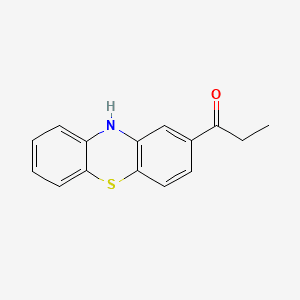

2-Propionylphenothiazine (CAS 92-33-1), chemically known as 1-(10H-phenothiazin-2-yl)propan-1-one, is a vital sulfur-nitrogen heterocyclic building block. In Elemental Derivatives hierarchy (Nitrogen/Sulfur Heterocycles path), it serves as the foundational core for the synthesis of "typical" first-generation antipsychotics and specialized sedatives. The structural architecture - a tricyclic phenothiazine ring with a propanoyl side chain - makes it the indispensable starting material for the production of Propiomazine and Butaperazine. For CDMOs and Bulk Pharmaceutical Manufacturers, this intermediate is a high-value "drug-linkable" node, where N-alkylation at the 10-position transforms it into active pharmacological agents. We are a globally established wholesale phenothiazine intermediates supplier and various pharmaceutical APIs, intermediates, excipients, finished formulations, and dosages from sourcing, r&d to manufacturing scaling through comprehensive regulatory documentation (CoA), compliances, traceability, and consistent worldwide supply capabilities, ensuring reliable lead times and quality assurance across all grades.


2-Propionylphenothiazine (CAS 92-33-1), chemically known as 1-(10H-phenothiazin-2-yl)propan-1-one, is a vital sulfur-nitrogen heterocyclic building block. In Elemental Derivatives hierarchy (Nitrogen/Sulfur Heterocycles path), it serves as the foundational core for the synthesis of "typical" first-generation antipsychotics and specialized sedatives. The structural architecture - a tricyclic phenothiazine ring with a propanoyl side chain - makes it the indispensable starting material for the production of Propiomazine and Butaperazine. For CDMOs and Bulk Pharmaceutical Manufacturers, this intermediate is a high-value "drug-linkable" node, where N-alkylation at the 10-position transforms it in...
Pharmaceutical
Pharmaceutical Actives & Precursors
Intermediates & Precursors
.7767eb0f.png)

Chemical Properties & Specifications
Acute Tox. 4 (50%), Skin Irrit. 2 (66.7%), Eye Irrit. 2A (83.3%), STOT SE 3(83.3%)
P261, P264, P264+P265, P270, P271, P280, P301+P317, P302+P352, P304+P340, P305+P351+P338, P319, P321, P330, P332+P317, P337+P317, P362+P364, P403+P233, P405, and P501
Condensed with 2-dimethylaminoisopropyl chloride in the presence of a strong base (like NaN H2 or KOH ) to yield the Propiomazine base
Industrial routes focus on minimizing isopropiomazine impurities by controlling regioselectivity during the 10-position alkylation
Labs' preference as a reference standard to detect unreacted intermediates or degradation products in finished phenothiazine dosages
Critical for validating HPLC/LC-MS methods under ICH guidelines for "process-related impurities"
Research-grade explored in the synthesis of organic photocatalysts due to the electron-rich nature of the sulfur-nitrogen tricyclic system.
MOA: Acts primarily as a potent Hi receptor antagonist and a dopaminergic/serotonergic blocker
Clinical Indications: Short-term treatment of insomnia, as a pre-surgical sedative to relieve anxiety, and as an adjunct to analgesics during labour.
MOA: High-potency Dz receptor antagonist in the mesolimbic pathway
Clinical Indications: Management of Schizophrenia and acute manic episodes in bipolar disorder.
Primary challenge is the regioselective N-alkylation. To ensure high purity and avoid the "isopropiomazine" isomer, process engineers must carefully select the base and solvent (often Toluene with KOH or NaN H2). Our high-purity (≥99%) intermediate ensures that side reactions involving the propionyl carbonyl group are minimized.
Under HS Code 2934.30, it is typically classified as a non-hazardous solid for transport, but it is light-sensitive. For B2B bulk orders, we utilize amber-lined fiber drums or UV-protected vacuum bags to prevent photo-oxidation, which can turn the orange powder into a dark brown/black degradant.
The electron-withdrawing nature of the propionyl group (compared to the chlorine in Chlorpromazine) significantly alters the drug's lipid solubility and receptor affinity. In Propiomazine, this specific substitution shifts the pharmacological profile away from extreme neuroleptic activity toward potent H1 antagonism (sedation).
Yes, in monographs for Propiomazine Maleate, 2-propionylphenothiazine is often monitored as a residual starting material. Manufacturers must demonstrate that it is below the threshold of toxicological concern (TTC) in the final API.
Yes with 2-propionylphenothiazine MSDS, propionylphenothiazine coa, HPLC analysis of phenothiazine impurities for procurement clarity along with manufacturing compliances adhering country specific regulatory.