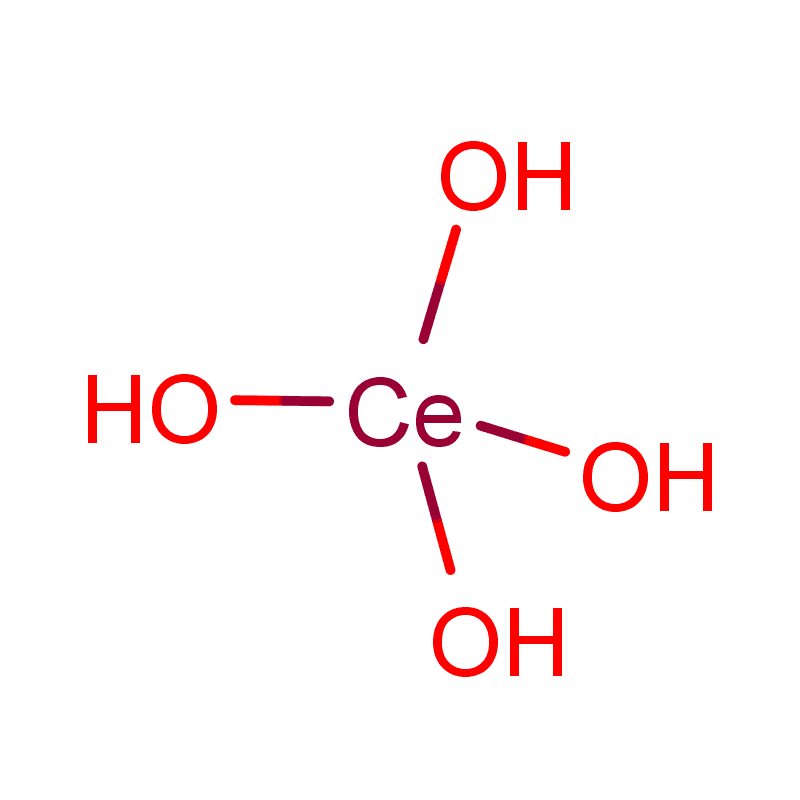


Cerium Hydroxide (CeOH₃) is a voluminous, gelatinous, light-coloured precipitate that is virtually insoluble in water. Key intermediate in the Rare Earth Separation process, often serving as the initial product isolated from the ore. Industrially, Cerium (IV) oxide hydrated's primary role is as a high-purity precursor, being easily calcined (heated) to produce Cerium Oxide (CeO₂) or readily dissolved to form various Cerium salts (e.g., Cerium Nitrate). Cerium tetrahydroxide's particle morphology is critical for its use in polishing, where it is often the final precursor before drying and milling. We are a leading & trusted Cerium Hydroxide supplier in the United States and worldwide, offering high-purity Cerium Oxide that meets quality and safety standards, with reliable lead times and global supply capability.

Cerium Hydroxide (CeOH₃) is a voluminous, gelatinous, light-coloured precipitate that is virtually insoluble in water. Key intermediate in the Rare Earth Separation process, often serving as the initial product isolated from the ore. Industrially, Cerium (IV) oxide hydrated's primary role is as a high-purity precursor, being easily calcined (heated) to produce Cerium Oxide (CeO₂) or readily dissolved to form various Cerium salts (e.g., Cerium Nitrate). Cerium tetrahydroxide's particle morphology is critical for its use in polishing, where it is often the final precursor before drying and milling. We are a leading & trusted Cerium Hydroxide supplier in the United States and worldwide, offerin...

Chemical Properties & Specifications
S26
R36
P260, P264, P271, P280, P301+P330+P331, P303+P361+P353, P304+P340, P305+P351+P338, P310, P321, P363, P403+P233, P405, and P501
Skin Corr. 1B (100%)
Eye Dam. 1 (100%)
Direct precursor to all grades of Cerium Oxide (CAS 1306-38-3), a process achieved through calcination (thermal decomposition)
Due to its basic nature and high surface area, utilized as a basic catalyst or catalyst support material in specific environmental and organic reactions
Сe(ОH)3 can be tailored during precipitation, making it an excellent starting material for high-performance CMP slurries and polishing powders
Used to prepare other high-purity Cerium salts (sulfates, nitrates) by reaction with the corresponding acid
a catalyst for automobile exhaust purification and various chemical reactions
a decolorant and clarifier in the glass and color TV industry
a raw material for the manufacture of various cerium salts and cerium naphthenate
a stabilizer for polyvinyl chloride (PVC) plastics
a paint drier in the synthesis of barium or cerium naphthalate
a spheroidizing agent for nodular cast iron and a raw material for smelting rare earth-rich ferrosilicon alloys
an additive in electroplating technology
a resin auxiliary and an ionic crosslinking agent
Store in Ambient temperature
Inert atmosphere
Room Temperature
Naturally gelatinous and holds a significant amount of water. Selling it as a wet cake saves drying energy costs and time, making it the most economical intermediate form for shipping to nearby processing plants that will immediately dissolve or calcine it.
Primary, stable Cerium(III) hydroxide is Ce(OH)з (CAS 12014-56-1). Ce(OH)4 (Cerium( IV hydroxide) is highly unstable and rapidly dehydrates to CeO2. In practice, most researchers use Ce(OH)3 as the starting point for Ce(III) chemistry.
For Polishing, the critical specification is the Cerium content (CeO equivalent) and the morphology (particle size/shape of the Ce(OH)₃). For Catalyst Grade, the focus is ultra-high purity (4N/5N) and minimal content of praseodymium (Pr) and neodymium (Na) to avoid poisoning the final TWC catalyst.
Most basic component was isolated in early precipitation steps during the complex solvent extraction of REEs. Provides a means to selectively remove Cerium from the lighter lanthanides early in the refining process due to the ability of Ce|II to be oxidised to Ce(IV) in basic solution.
While CeOH3 is a low-toxicity solid, bulk transport of the wet cake/paste grade requires handling as an inorganic powder. The $\text{UN}$ classification focuses on its non-hazardous nature, but standard industrial hygiene practices (dust control) are essential.
No, Ce(OH)3 is not used directly. While the Cest ion will bind phosphate, the Hydroxide form is too insoluble and basic. Soluble Cerium Chloride or Cerium Sulfate salts are used instead, as they dissolve and immediately release the Cet ions required to precipitate the phosphate.
Cerium Hydroxide is an inorganic compound, often appearing as a light yellow or brownish yellow powder, used primarily as a catalyst, glass decolorizer, and intermediate in the production of various cerium salts
This compound is universally utilized in the glass, chemical, metallurgical, electronics, and automotive industries, as well as in biomedical research for its catalytic and antioxidant properties
It is used in glass clarifying agents, automotive catalytic converters, PVC stabilizers, paint driers, and electroplating additives, typically showing solubility in concentrated acids while remaining insoluble in water
Standard specifications include CAS number 12014-56-1, a molecular weight of 208.15 g/mol, and documentation such as COA, TDS, impurity reports, and regulatory compliance documents
Scimplify has capabilities for global distribution and custom synthesis through an integrated network of manufacturers and logistics partners with reliable lead time
The product is export ready with a standard MOQ starting from 100 kgs, with lead times for international customers depending on the shipping destination and specific grade.
Category : Metal Compounds & Salts
Sub-Category : Nickel Compounds
Description : Nickel Sulfate Monohydrate (CAS No: 14104-80-4) is a high-value inorganic compound that occupies a s...
Category : Metal Compounds & Salts
Sub-Category : Specialty Organometallic Compounds
Description : Molybdenum hexacarbonyl is an essential high-performance zero-valent coordination complex that occup...
Category : Electronic & Specialty Grade Materials
Sub-Category : High Purity Metals, Compounds & Powders