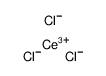


Cerium(III) Chloride (CeC13) is a crucial inorganic salt and the most common water-soluble compound of the rare-earth element RRe - Cerium (Ce). Cerous Chloride, a primary, highly reactive source for the trivalent cerium ion (Ce³⁺), making it indispensable in modern chemical synthesis, advanced material production, and environmental technologies. Industrially, Cerium Chloride gaining prominence as an advanced, non-toxic coagulant for nutrient removal in water treatment. Due to its hygroscopic nature, Cerium Trichloride, is commercially supplied in three distinct forms to suit various purity and application needs: Anhydrous Crystal, highly soluble Heptahydrate Crystal (standard lab grade), and Aqueous Solution. We are leading & trusted Cerium Chloride supplier & Cerium chloride heptahydrate in the United States and worldwide, offering high purity Cerium grades that meet US quality and safety standards, with reliable lead times and global supply capability.

Cerium(III) Chloride (CeC13) is a crucial inorganic salt and the most common water-soluble compound of the rare-earth element RRe - Cerium (Ce). Cerous Chloride, a primary, highly reactive source for the trivalent cerium ion (Ce³⁺), making it indispensable in modern chemical synthesis, advanced material production, and environmental technologies. Industrially, Cerium Chloride gaining prominence as an advanced, non-toxic coagulant for nutrient removal in water treatment. Due to its hygroscopic nature, Cerium Trichloride, is commercially supplied in three distinct forms to suit various purity and application needs: Anhydrous Crystal, highly soluble Heptahydrate Crystal (standard lab grade), an...

Chemical Properties & Specifications
S26-S36
P261; P305 + P351 + P338
H315; H319; H335
UN 3260 (Corrosive Solid, Acidic, Inorganic, N.O.S.)
8
Phosphate removal, Wastewater treatment, Heavy metal removal, CeC13 coagulant, Cerium trichloride solution
Advanced coagulant for the highly effective phosphate removal and fluoride scavenging in municipal/industrial wastewater treatment to meet discharge compliance. Improves sludge dewatering and minimizes corrosion
Cerium metal production, Corrosion inhibitor, Hard alloy additive
Raw material for producing high-purity Cerium metal via fused-salt electrolysis. Used in protective coatings and as an additive in hard alloys
CeO2 precursor, Phosphor production, Nanometal oxide synthesis
Precursor for synthesizing Cerium(IV) Oxide (CeO2) nanoparticles used as polishing agents and in catalysis. Essential for manufacturing phosphors to enhance the brightness and efficiency of LEDs, fluorescent lamps, and other luminescent devices
Luche reduction, CeCI Lewis acid, Catalyst precursor, CeCl alkylation, Organic synthesis reagent
Functions as a mild Lewis acid catalyst for key organic transformations. Essential for the Luche reduction (selective reduction of a, B-unsaturated carbonyls) and for facilitating the alkylation of ketones, overcoming enolate formation issues
A Lewis acid catalyst that imparts high regio- and chemoselectivity to various chemical transformations such as C-C bond formation and reduction of C-O double bonds
A catalyst used in petrochemical cracking and as a component in automotive exhaust catalysts
A coagulant and sequestrant used to remove phosphates, fluorides, and heavy metals from municipal and industrial wastewater
A valuable reagent used for synthesizing methoxime derivatives and facilitating the ring-opening of epoxides
A precursor for the production of cerium oxide nanoparticles, phosphors for lighting, and additives for perovskite solar cells
A vital material used in the glass and ceramics industries to enhance product quality and consistency
A reagent used in electroplating processes
A compound utilized in fuel cell research and development
Storage Hygroscopic
Store under Nitrogen
Maintain Ambient temperature
Tightly closed container
Under an inert atmosphere
Anhydrous grade is essential for moisture-sensitive applications, particularly in polymerization catalysis and advanced metallurgy where trace water would interfere with the reaction. The Hydrate grade (CeCl • 7H,O) is the most stable and cost-effective form for general plating, Ce coating, and water-soluble applications.
Yes. Our Cerium Chloride is typically synthesized for Electronic & Specialty Grade Materials applications. We focus on low levels of heavy metal and other lanthanide impurities, providing High Purity (4N to 5N) grades required for phosphors, LED components, and specialized ceramics.
CeCl3 acts as a Lewis Acid to coordinate with the carbonyl group, which stabilizes the intermediate and directs the reducing agent ( NaBH4) to selectively attack the ketone or aldehyde, leaving the a, B-unsaturated double bond intact.
Offers performance gains by effectively reducing phosphorus to stringent benchmarks. Unlike iron/aluminum salts, it causes less discoloration and corrosion, has a low freezing point (improving operational stability), and significantly enhances particle aggregation, leading to improved solids management and lower sludge volumes.
CeCl serves as the primary, highly pure precursor chemical. High solubility and reactivity allow researchers to control precipitation and hydrothermal processes to precisely synthesize CeOz in its nano-form for use in catalysis, polishing, and electrochemical sensors.
Cerium trichloride anhydrous form must be used for any reaction that is highly sensitive to water, particularly those involving strong nucleophiles like Grignard or organolithium reagents, where water would quickly quench the reagent, preventing the desired reaction.
Cerium chloride is a white, hygroscopic rare earth compound with the molecular formula CeCl3, primarily used as a versatile catalyst in organic synthesis, a Lewis acid in Friedel-Crafts reactions, and as a precursor for other cerium salts
This compound is universally utilized in the automotive, petrochemical, water treatment, glass and ceramics, and pharmaceutical industries
It is used as a water-soluble crystalline source in wastewater treatment coagulants, automotive catalytic converters, specialized glass formulations, and as a reagent in ethanol or acetone for organic synthesis
Standard specifications include CAS number 7790-86-5, a molecular weight of 246.48 g/mol (anhydrous), high purity (99% to 99.999%), and documentation such as COA, TDS, impurity reports, and regulatory compliance documents
Scimplify has capabilities for global distribution and custom synthesis through an integrated network of manufacturers and logistics partners with reliable lead time
The product is export ready with a standard MOQ starting from 100 kgs, with lead times for international customers depending on the shipping destination and specific grade.
Category : Metal Compounds & Salts
Sub-Category : Nickel Compounds
Description : Nickel Sulfate Monohydrate (CAS No: 14104-80-4) is a high-value inorganic compound that occupies a s...
Category : Metal Compounds & Salts
Sub-Category : Specialty Organometallic Compounds
Description : Molybdenum hexacarbonyl is an essential high-performance zero-valent coordination complex that occup...
Category : Electronic & Specialty Grade Materials
Sub-Category : High Purity Metals, Compounds & Powders