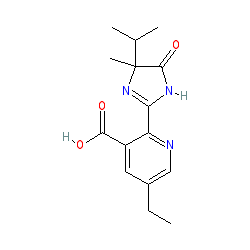

Imazethapyr is a selective, systemic herbicide belonging to the imidazolinone class. It is used for pre-emergence and post-emergence control of broadleaf weeds and grasses in a variety of crops. Imazethapyr inhibits acetohydroxyacid synthase (AHAS), an essential enzyme in the biosynthesis of branched-chain amino acids, which leads to plant growth suppression and eventual death.

Chemical Properties & Specifications
Acute Toxicity (Oral): Category 4 Skin Irritation: Category 2 Eye Irritation: Category 2A Hazardous to the Aquatic Environment (Chronic): Category 2
H302: Harmful if swallowed. H315: Causes skin irritation. H319: Causes serious eye irritation. H411: Toxic to aquatic life with long-lasting effects.
P264: Wash hands thoroughly after handling. P280: Wear protective gloves, clothing, and eye protection. P302+P352: IF ON SKIN: Wash with soap and water. P305+P351+P338: IF IN EYES: Rinse cautiously with water for several minutes. Remove contact lenses if present and easy to do – continue rinsing. P273: Avoid release to the environment. P391: Collect spillage.
Used for pre-emergence and post-emergence control of broadleaf weeds and grasses in soybeans, groundnuts, and pulses.
Effective against weeds in direct-seeded and transplanted rice fields.
Applied in leguminous crops and vegetable cultivation.
Store in a cool, dry place at temperatures between 2–8°C (35–46°F).
Keep away from moisture, direct sunlight, and oxidizing agents.
Store in airtight, non-reactive containers to maintain stability.
Available in 1 kg, 5 kg, 10 kg (WG) packaging for industrial and commercial use.
It inhibits acetohydroxyacid synthase (AHAS), preventing amino acid biosynthesis in susceptible weeds.
Primarily used in soybeans, pulses, peanuts, rice, and vegetable crops.
It is both pre-emergence and post-emergence, offering residual weed control.
It has low residual activity, allowing for crop rotation flexibility.
Yes, it is compatible with various herbicides for integrated weed management.
When used as directed, it is considered low in toxicity, but protective equipment should be used.
Category : Plant Health, Nutrients & Soil Management
Sub-Category : Fertilizers & Nutrients
Category : Agrochemical Intermediates
Sub-Category : Specialty & Advanced Intermediates
Description : 2-Isopropoxyethylamine (CAS 81731-43-3), often used interchangeably with CAS 83495-51-6, is a specia...
Category : Crop Protection & Pest Control
Sub-Category : Insecticides
Description : Clothianidin is a systemic broad-spectrum, neonicotinoid insecticide used to control sap-sucking ins...
Category : Plant Health, Nutrients & Soil Management
Sub-Category : Plant Growth Regulators & Harvest Aids
Description : Phosphorous acid (CAS 13598-36-2) serves as a vital reducing agent and intermediate in the API inter...