Search through


Triethanolamine (TEA), is a tertiary amine and a triol. Within the Industrial Chemicals, Beauty & Personal Care, and Metallurgy hierarchies, it is a flagship multifunctional agent. I2,2',2''-Nitrilotriethanol's unique ability to act as a weak base, a humectant, and a high-efficiency chelator makes it the "go-to" ingredient for neutralizing fatty acids, stabilizing emulsions, and enhancing the grindability of industrial minerals. Source High-Purity Triethanolamine (CAS 102-71-6) from Scimplify, a leading global manufacturer and wholesale supplier of alkanolamines. Known as TEA, this tertiary amine is a critical pH adjuster and emulsion stabilizer essential for the cosmetic, detergent, and cement industries. Our bulk Triethanolamine is a high-performance surfactant intermediate used to produce TEA-lauryl sulfate and TEA-oleate. As an authoritative alkanolamine supplier, we provide TEA that serves as a vital grinding aid in cement manufacturing and a primary corrosion inhibitor in metalworking fluids. Whether you are formulating hypoallergenic skin care or industrial-strength degreasers, Scimplify ensures global regulatory compliance, delivering low-color, high-stability material with full COA/SDS transparency and reliable global lead times.
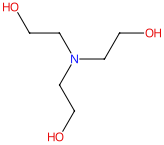
Triethanolamine (TEA), is a tertiary amine and a triol. Within the Industrial Chemicals, Beauty & Personal Care, and Metallurgy hierarchies, it is a flagship multifunctional agent. I2,2',2''-Nitrilotriethanol's unique ability to act as a weak base, a humectant, and a high-efficiency chelator makes it the "go-to" ingredient for neutralizing fatty acids, stabilizing emulsions, and enhancing the grindability of industrial minerals. Source High-Purity Triethanolamine (CAS 102-71-6) from Scimplify, a leading global manufacturer and wholesale supplier of alkanolamines. Known as TEA, this tertiary amine is a critical pH adjuster and emulsion stabilizer essential for the cosmetic, detergent, and cem...

.3d8f8f41.svg)
Industrial Chemicals
.3556d45a.svg)

Organic Intermediates


Amines & Amino Alcohols
.7767eb0f.png)

Chemical Properties & Specifications
26-39-36
36/37/38-36
H315
Primary agent used to neutralize carbomers and fatty acids (like stearic acid) to create stable, clear gels and creams. Acts as a buffer and emulsifier, ensuring that lotions have a skin-compatible pH and a smooth, non-greasy texture
In the cement industry-chemical grinding aid. Prevents agglomeration of particles on the grinding balls, significantly increasing mill efficiency. In metalworking, provides a protective alkaline film on surfaces to prevent rust
While less reactive than MEA or DEA, TEA is used in specialised gas-treating applications where selective removal of HaS is required. Serves as a cross-linking agent in specialty Polyurethane (PU) foams and epoxy resins
Hygroscopic and light-sensitive. Turns brown upon exposure to air and light due to oxidation. It has a freezing point of 20.5°C (69°F) and may require warming in winter
Store in stainless steel or opaque HDPE containers. Maintain a Dry Nitrogen Blanket to prevent color degradation. Store away from strong acids and oxidizing agents.
Non-hazardous for transport in most jurisdictions. Available in 230kg steel/plastic drums, 1000kg IBCs, and ISO tanks.
TEA 99% is the high-purity grade preferred for cosmetics and pharma, containing minimal Diethanolamine (DEA). TEA 85% contains approximately 15% DEA and is typically used in industrial applications like cement grinding or metalworking where extreme purity is less critical but cost-efficiency is paramount.
Color stability is our priority. We monitor the APHA color score (typically <20) and utilize nitrogen-blanketing from production to final packaging. We recommend using the material within 6-12 months to ensure it remains water-white for your formulations.
Yes. Triethanolamine is a Schedule 3 chemical under the CWC. We maintain all necessary export/import permits and ensure that B2B transactions comply with international monitoring requirements for "dual-use" chemicals.
Absolutely. TEA acts as a "flash rust" inhibitor. By maintaining an alkaline pH in the water-based system, it prevents the oxidation of steel cans and provides a level of corrosion protection for the substrate once the paint is applied.