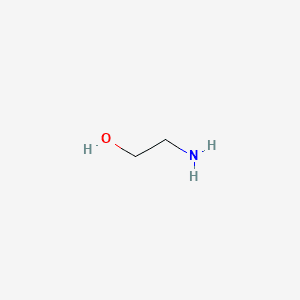

Ethanolamine / Monoethanolamine (C₂H₇NO) is the simplest stable amino alcohol organic compound, featuring both a primary hydroxyl group (-OH) and a primary amine group (-NH₂). Unique combination of these functionalities makes it a highly amphoteric and versatile industrial chemical. The compound's versatility is primarily harnessed in two areas: as an effective amine scrubber for removing acidic gases (CO₂, HS) in gas processing and key intermediate in the production of fatty acid soaps, detergents, and chelating agents. Also called as ‘MEA, B-Aminoethanol, 2-aminoethanol’ by ethanolamine manufacturers. We are leading & trusted ethanolamine suppliers in the United States and worldwide, offering high-quality ethanolamine grades that meet US quality and safety standards, with reliable lead times and global supply capability.


Ethanolamine / Monoethanolamine (C₂H₇NO) is the simplest stable amino alcohol organic compound, featuring both a primary hydroxyl group (-OH) and a primary amine group (-NH₂). Unique combination of these functionalities makes it a highly amphoteric and versatile industrial chemical. The compound's versatility is primarily harnessed in two areas: as an effective amine scrubber for removing acidic gases (CO₂, HS) in gas processing and key intermediate in the production of fatty acid soaps, detergents, and chelating agents. Also called as ‘MEA, B-Aminoethanol, 2-aminoethanol’ by ethanolamine manufacturers. We are leading & trusted ethanolamine suppliers in the United States and worldwide, offer...
Industrial Chemicals
Organic Intermediates
Amines & Amino Alcohols
.7767eb0f.png)

Chemical Properties & Specifications
GHS05;GHS07
R20/21/22; R34
S26; S36/37/39; S4
For amine scrubbing processes to selectively remove CO₂ and H₂S from natural gas, refinery gas, and synthesis gas (gas sweetening)
Mild alkali for pH adjustment in water treatment and chemical processing
Synthesis of certain herbicides and as a salt former to increase the water solubility of active ingredients in fertilizer and crop protection formulations
Reacts with fatty acids to form alkanolamide surfactants and MEA soaps, which are used as emulsifiers, detergents, and dispersing agents in cleaning products
Neutralizes acidic components in hair dyes, creams, and lotions, providing a stable emulsion and modifying viscosity
Store in tightly closed containers in a cool, dry, and well-ventilated area, away from incompatible materials
Moisture (highly hygroscopic) and CO2 (reacts to form a solid carbonate salt, leading to caking or reduced purity)
Due to its corrosive nature, storage vessels are often made of stainless steel or carbon steel, or high-density polyethylene (HDPE)
MEA (Mono) is the most reactive due to its primary amine structure, providing the fastest reaction rate for CO2 and H≥S removal, but it is also the most corrosive and requires the highest regeneration energy.
The gas sweetening industry requires a high-purity, often > 99% grade, as impurities can cause corrosion, foaming, and degradation in the closed-loop scrubbing system.
Bulk MEA is typically transported in steel drums, IBC totes, and tank trucks/cars, often requiring nitrogen blanketing to prevent CO2 absorption and carbonate formation during long-term storage or transit.
A 10% aqueous solution of MEA typically has a basic pH in range of 11.5 to 12.5, reflecting its strong basicity as an amine.
Forms a fatty acid alkanolamide or an amine soap. These are non-ionic or anionic surfactants, respectively, widely used for their foam-stabilizing and emulsifying properties in shampoos and liquid detergents.
The amine group is highly polar and forms strong hydrogen bonds with water molecules (hygroscopic). The lone pair of electrons on the amine nitrogen readily attacks the electrophilic carbon in CO2, forming a stable carbamate salt.