Search through


Ethyl Centralite (1,3-Diethyl-1,3-diphenylurea), recognised globally as Centralite I, is the industry-standard stabiliser and burning rate moderator for advanced nitrocellulose-based systems. Its superior compatibility with nitroglycerin makes it an indispensable component in high-performance ballistics. Ethyl Centralite (CAS: 85-98-3) is characterised by its lower melting point (72°C) compared to its methyl counterpart, which allows for easier incorporation and gelatinisation in solventless propellant manufacturing. As a leading CDMO partner, we optimise the production of Centralite I to ensure a crystalline form that exhibits high solubility in organic solvents (Ethanol/Acetone) and explosive oils like Nitroglycerin. Our GMP manufacturing process ensures the removal of low-volatility impurities that could otherwise cause "sweating" or surface migration in finished ammunition.By maintaining a rigorous API scale-up mentality for industrial chemicals, we provide a product with the high-authority technical profile required for military contracts and Tier-1 commercial ammunition production. We provide industrial-scale Ethyl Centralite. Our facility supports the entire lifecycle from process development to a 20 MT+ annual supply, backed by comprehensive Ethyl Centralite COA, TDS, and global regulatory compliance documentation (REACH/TSCA).
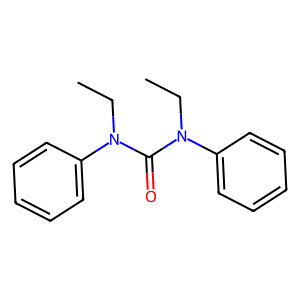
Ethyl Centralite (1,3-Diethyl-1,3-diphenylurea), recognised globally as Centralite I, is the industry-standard stabiliser and burning rate moderator for advanced nitrocellulose-based systems. Its superior compatibility with nitroglycerin makes it an indispensable component in high-performance ballistics. Ethyl Centralite (CAS: 85-98-3) is characterised by its lower melting point (72°C) compared to its methyl counterpart, which allows for easier incorporation and gelatinisation in solventless propellant manufacturing. As a leading CDMO partner, we optimise the production of Centralite I to ensure a crystalline form that exhibits high solubility in organic solvents (Ethanol/Acetone) and explos...

.3d8f8f41.svg)
Industrial Chemicals
.3556d45a.svg)

Specialty Chemicals


Explosive Stabilizers & Propellant Additives
.7767eb0f.png)

Chemical Properties & Specifications
Acute Tox. 4 (100%), Aquatic Chronic 3 (100%)
P264, P270, P273, P301+P317, P330, and P501
Primary chemical buffer in double-base and triple-base propellants, capturing nitric acid to prevent the structural degradation of the powder grains
High concentrations (3%–10%) function as a moderant or gelatiniser, allowing for the precise control of the propellant's combustion curve (ballistic pressure profile)
Definitive organic marker in Gunshot Residue (GSR) analysis, used by forensic scientists to link suspects to the discharge of firearms
Key building block in the custom synthesis of speciality pharmaceutical actives requiring symmetrical urea scaffolds
Low-quality stabilisers often contain residual ethylaniline or trace acidity, which shortens the propellant's life and necessitates frequent surveillance testing. By sourcing our ≥ 99.5% pure Ethyl Centralite, R&D Scientists can achieve a more uniform gelatinization of the nitrocellulose matrix. For Sourcing Managers, this translates to reduced material waste, fewer batch rejections during ballistics testing, and a significantly lower risk of spontaneous auto-ignition in storage depots-protecting both capital assets
We scimplify bridge the gap between chemistry and commerce through rigorous process validation. Our GMP manufacturing line for Centralite I utilizes automated crystallization and drying units that eliminate batch-to-batch variability. This ensures that the particle size and chemical assay remain constant over metric-ton deliveries, allowing your automated mixing and extrusion lines to run at peak efficiency without the need for constant recalibration.
The primary differentiator lies in the gelatinizing power and thermal transition (Ig) of the nitrocellulose matrix. Ethyl Centralite (Centralite I) has a lower melting point (~ 72 °C) and higher lipophilicity, making it a superior moderant for double-base propellants where deep penetration into the NC grain is required for burning rate control. Methyl Centralite (Centralite II), with a higher melting point (~ 121°C), is often preferred in high-load structural propellants where increased thermal stiffness is required. Our CDMO expertise allows us to provide custom-tailored particle sizes for both, ensuring uniform dispersion and preventing localised "hot spots" during combustion.
"Total Cost of Quality" in defence chemicals is measured in shelf-life. Trace moisture or residual secondary amines in low-grade Centralites act as catalysts for the hydrolysis of nitrate esters. We utilise a proprietary multi-stage recrystallisation process that reduces moisture to ≤ 0.1% and limits residual acidity to nearly undetectable levels (< 0.01%). This scientific rigor ensures that our Centralites function strictly as "acid traps," scavenging NOx gases without initiating side reactions, thereby extending ammunition shelf-life by up to 25% compared to standard industrial grades.
Procurement for Centralites is often plagued by the oscillating prices of N-methylaniline and N-ethylaniline. As an integrated manufacturer, we maintain strategic reserves and long-term contracts for these primary precursors. By partnering with us under a dedicated CDMO agreement, you move away from spot-market pricing. We provide a "Price-Lock" stability framework and a guaranteed "Regulatory Continuity" (REACH/TSCA), ensuring your long-term defence contracts remain profitable and compliant regardless of global chemical market shifts.
In aerospace propellants, "stabiliser migration" or evaporation can lead to catastrophic failure. Methyl Centralite (Centralite II) exhibits lower volatility and lower vapor pressure than its ethyl counterpart. This makes it the high-authority choice for rocket motors and missiles stored in extreme environments. Our R&D team provides specific vapor pressure data and sublimation kinetics to help your ballistics engineers model stabilizer depletion over 20-year lifecycles, establishing product stability in extreme environment chemistry.
Yes Absolutely. The industry is moving toward "REACH-compliant" and "Lead-Free" energetics. Our Custom Synthesis division is equipped to produce novel symmetrical and asymmetrical urea derivatives (Centralite analogues) that offer higher nitrogen content or reduced toxicity. We offer a "Lab-to-Launch" pathway, providing 1kg batches for initial SAR studies and scaling to 10MT+ for commercial qualification, ensuring your R&D pipeline is supported by a partner with deep market intelligence.
We scimplify bridge the gap between production and compliance by providing an exhaustive Technical Data Package for every batch. This includes GC-MS profiles for organic impurities, FT-IR spectra for structural verification, and XRD data for crystallinity checks. For Sourcing Managers, this documentation serves as "Pre-Validated Authority," significantly reducing your internal QC overhead and speeding up the acceptance process for government and Tier-1 defence contractors.
It is vital for international trade and environmental compliance in the EU and global markets.