Search through
Hero BG
Rounded Bottom

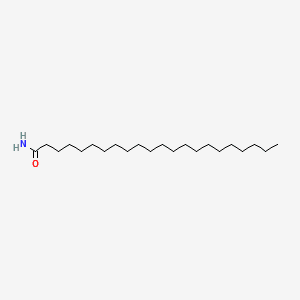
Docosanamide (CAS NO : 3061-75-4)

Behenamide, also known as Docosonamide (CAS No. 3061-75-4), is a long-chain primary fatty acid amide widely used as a high-performance slip agent, anti-blocking agent, and processing aid in polymer and industrial applications. Classified within the fatty amide chemical class, it is derived from behenic acid and provides controlled surface migration, reducing friction and improving release properties in polyolefins such as polyethylene (PE), polypropylene (PP), EVA, and engineering plastics. Its mechanism involves forming a microscopic lubricating layer on polymer surfaces, which lowers the coefficient of friction, enhances film handling, improves scratch resistance, and ensures smooth extrusion and molding performance in high-speed manufacturing environments. Supplied as a stable white crystalline powder or flakes, Behenamide offers excellent thermal stability, compatibility with polymer matrices, and consistent dispersion, making it essential for plastic film production, extrusion, injection molding, coatings, and specialty industrial formulations. As an established Behenamide manufacturer and supplier in the USA, Scimplify delivers high-purity material with controlled specifications, batch traceability, and comprehensive documentation, including COA and SDS, to support polymer compounders, packaging manufacturers, and industrial processors requiring reliable performance, regulatory alignment, and dependable supply continuity.

Docosanamide
Docosanamide

Behenamide, also known as Docosonamide (CAS No. 3061-75-4), is a long-chain primary fatty acid amide widely used as a high-performance slip agent, anti-blocking agent, and processing aid in polymer and industrial applications. Classified within the fatty amide chemical class, it is derived from behenic acid and provides controlled surface migration, reducing friction and improving release properties in polyolefins such as polyethylene (PE), polypropylene (PP), EVA, and engineering plastics. Its mechanism involves forming a microscopic lubricating layer on polymer surfaces, which lowers the coefficient of friction, enhances film handling, improves scratch resistance, and ensures smooth extrus...

industries-sectionindustries

Industry

Oleochemicals

category-sectioncategory

Category

Waxes & Lubricants

sub-category-sectionsub-category

Sub-category

Fatty Amide Slip Agents

Get a Quote

Details included in quote

Minimum Order Quantity

Lead Time

Regional Availability

Incoterms

Intersect
Rounded Top

Chemical Properties & Specifications

Applications of Docosanamide

Plastics & Polymers: High-Temperature Slip Agent

Polyolefins (PP, PE) and engineering resins (ABS, PS). Higher melting point than Erucamide, remains stable during high-temperature processing. Migrates to the surface to form a microscopic lubricating layer that prevents films from sticking together (anti-blocking) and allows them to slide easily over metal rollers (slip)

Printing Inks & Coatings: Scuff Resistance

Improves rub resistance and scuff resistance in flexographic and gravure inks. Provides a smooth, slippery surface to the dried ink film, protecting the printed graphics from damage during transit and handling

Metallurgy: Mold Release & Metal Drawing

High-performance mold release agent in metal powder metallurgy and as a lubricant in metal drawing processes. High thermal stability ensures it does not char or leave residues on the metal surface during heat treatment

Have Questions About Docosanamide?
We've Got Answers.

Erucamide is often the standard, but it has lower thermal stability. If your extrusion temperature exceeds 220°C, Erucamide can degrade, leading to yellowing and odor. Behenamide remains thermally stable at higher temperatures, ensuring better color and clarity in the final product.Q1 [Polymer Engineer]: Why use Behenamide instead of Erucamide for my PP film? A: Erucamide is often the standard, but it has lower thermal stability. If your extrusion temperature exceeds 220°C, Erucamide can degrade, leading to yellowing and odor. Behenamide remains thermally stable at higher temperatures, ensuring better color and clarity in the final product.

Like all slip agents, excessive migration can interfere with heat sealing or ink adhesion. However, because Behenamide is a saturated C22 chain, its migration rate is more "predictable" and "stable" than unsaturated amides, allowing for tighter control over the surface properties without compromising bond strength.

We supply 100% Vegetable-derived Behenamide, typically from Rapeseed or Mustard oil feedstocks. This ensures it is suitable for vegan-friendly packaging and meets global requirements for TSE/BSE-free materials.

Yes. Our Behenamide is manufactured in accordance with strict GMP guidelines and complies with FDA 21 CFR 175.105 and related sub-sections for use in food packaging materials.

The moq to buy docosanamide 98% Powder or Bulk Docosanamide Pellets Wholesale specification shared upon sourcing along with Behenamide coa, sds.

Suggested Products

C 9 Solvent CABS 70%
top-right-icon

C 9 Solvent CABS 70%

CAS No. : 26264-06-2

View Product
Cashew Nut Shell Liquid Residol Oil
top-right-icon

CAS No. : 8007-24-7

View Product
Cashew Nut Shell Oil
top-right-icon

Cashew Nut Shell Oil

CAS No. : 8007-24-7

View Product
Cardanol
top-right-icon

Cardanol

CAS No. : 37330-39-5

View Product

Get a Quote

Get a Quote